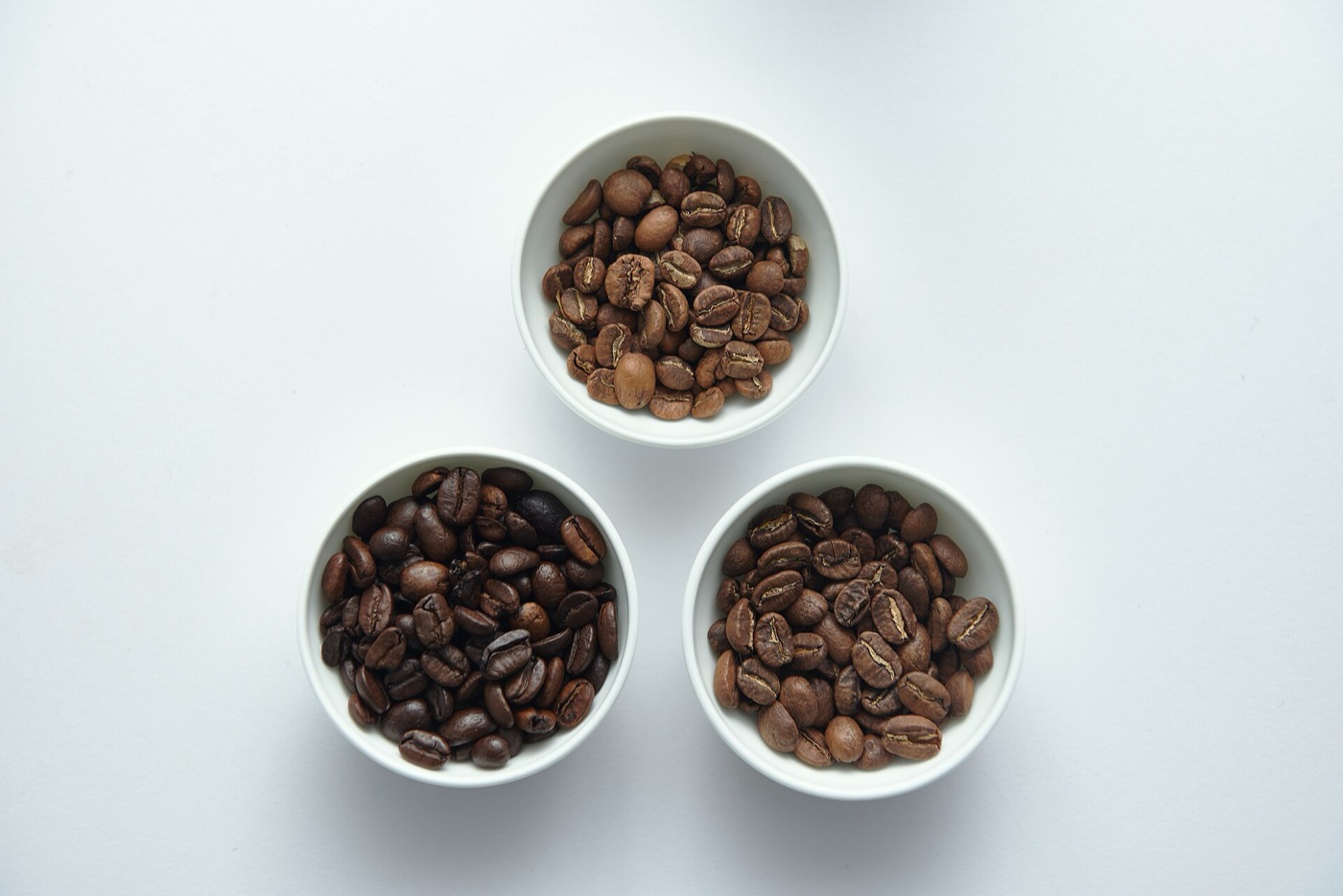
Three words carry most of the roast information a shopper sees: light, medium, dark. They are useful only if you know what they are naming — the moment a roaster decided to stop heating — and what they leave out, which is the mass that was lost, the colour that was reached, and the time spent after the first crack.
Each of those four things is measurable, and each one survives the trip between roasters in a way an adjective does not. What follows is where the common figures sit, and how to use them when two bags in front of you both say medium.
The label names a stopping point
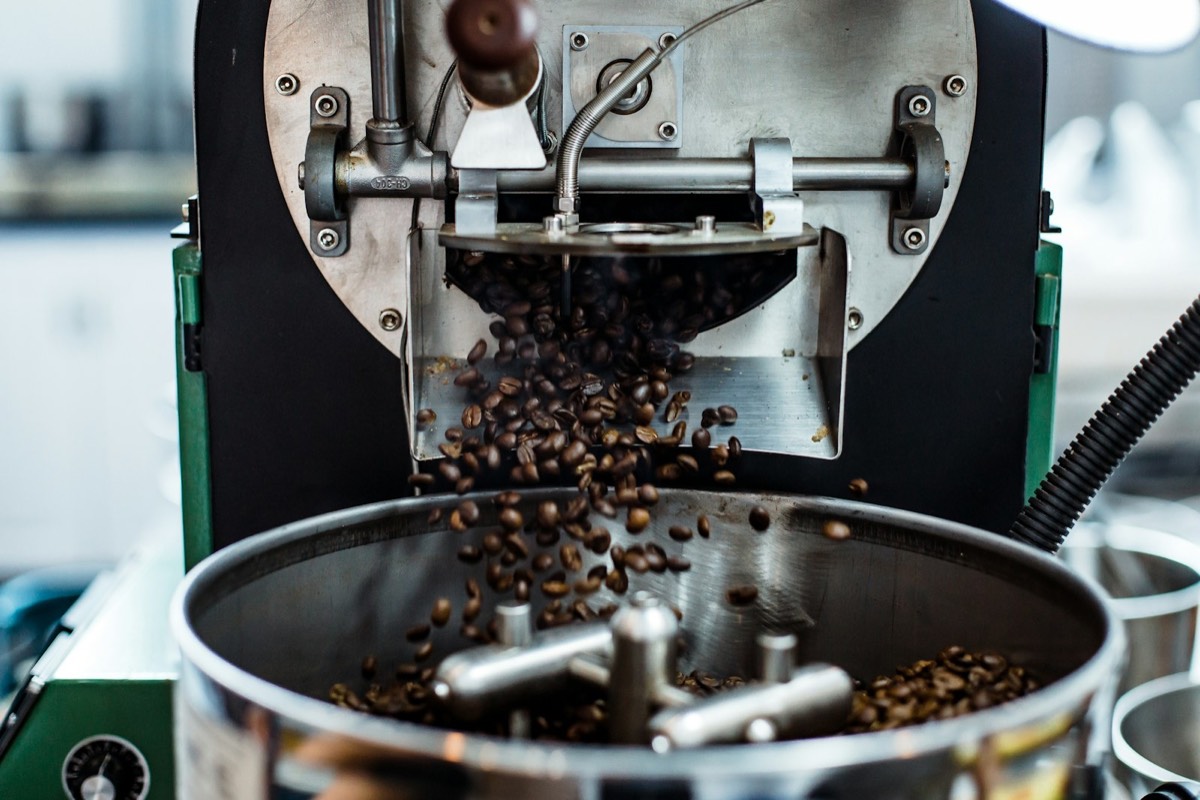
A roast is a curve, not a setting. Green beans are charged into a heated drum or air roaster, lose water as they heat, and are dropped into a cooling tray at a chosen moment; the label records that moment. Bean temperature around 196–205 °C is where the first crack becomes audible, and a typical drum roast gets there between the sixth and twelfth minute, then finishes a short way past it.
Because the label marks the end of the curve rather than its shape, two coffees dropped at the same colour can have followed very different paths to get there. Time to first crack and the length of the phase after it are separate variables, and they are the ones a roaster usually adjusts when a lot tastes thin or sharp.
First crack and second crack: the ear as a thermometer
The cracks are the roast's audible landmarks, and each corresponds to a temperature window rather than to a matter of taste. The same window shows up at first crack — roughly 196–205 °C — the sound of water turning to steam and cell walls giving way. Second crack arrives near 224–230 °C, when the structure starts to fracture and oils migrate to the surface of the bean.
Everything between them is the menu of roast levels. Roasters place their drop relative to these two events, and they time the later phase as a share of the whole roast: development time is often held at 20–25% of total roast time. A batch dropped soon after first crack is light by construction; one carried past second crack is dark by construction.
The same landmark explains why dark roasts taste the way they do. Past second crack, much of the sugar that survived the earlier stages has been consumed, and the aromatics that read as the bean's origin give way to notes the roast itself produced.
Roast loss, moisture and density
Green beans arrive at the roaster holding water. Roasting drives most of it off and also consumes part of the dry matter, and the scale records the total as roast loss: the fall in mass from green to roasted, commonly 13–20% from the light end to the dark end.
- Moisture in — the water a green bean carries when it is charged, commonly 10–12%.
- Roast loss — green mass that never comes back: about 13% at the light end, closer to 20% at the dark end.
- Bulk density — green coffee sits near 0.6–0.75 g/mL; after roasting the same beans measure roughly 0.35–0.45 g/mL.
- Volume — beans swell by roughly half to double their original size, so a full hopper of green coffee looks smaller once roasted.
Roast loss has consequences beyond the label. A 20 kg green batch leaves 2.6–4 kg behind in water and volatiles by the time it is bagged. Density explains the feel of the beans: a dark roast pours out of a scoop faster at the same weight, and it fills a hopper differently at the same dose.
Colour readings: the number that travels
Colour is the part of roasting with a published instrument scale. Agtron-type readings run from 0 to 100 with higher numbers lighter, fixed by reference discs that define the endpoints. The complication is that whole-bean and ground samples are read on two separate scales, so the same roast does not produce the same number on both.
A colour value is only comparable when the scale and the device are known, which is why a reading printed beside the label is worth more than the adjective printed in front of it. It also gives you a baseline: match the number from a bag you liked, and you have a target for the next purchase.
Colour and flavour are separate axes. Two roasts can be matched on colour while differing in how long they spent after first crack, and that phase is what most directly moves sweetness and acidity in the cup. A shop that prints both a colour reading and a development time is describing the roast rather than naming it.
What the darker roast changes inside the bean
Roast degree drives a set of chemical changes, and the direction of each change is known well enough to be useful when two bags are compared.
- Chlorogenic acids — the largest acid family in green coffee; their content falls steeply through the roast, dropping by roughly 50–70% across the full range from light to dark.
- Sucrose — the main soluble sugar at the start. Most of it is consumed once a roast passes a medium colour, which is a large part of why light roasts read sweeter on the label and not always in the cup.
- Quinic acid — a breakdown product rather than an acid the bean starts with; it accumulates as chlorogenic acids degrade and is associated with the drying, faintly sour finish of dark roasts.
- Carbon dioxide — production peaks at the end of the roast. The gas keeps leaving the bean for days afterwards, which is the reason a rest period is standard before a coffee is used for espresso.
How far each of those changes gets within a given colour also depends on the coffee itself. Composition varies with growing environment and processing, so an identical curve does not deliver an identical cup across two origins.
Comparing two bags that both say "medium"
Order of operations at the counter:
- Ask for the roast date and either the drop temperature or a colour reading. A label carrying one of those can be compared with the last bag you bought; a label carrying none cannot.
- Compare colour readings only within one scale. A whole-bean figure and a ground figure for the same roast are different numbers, not a disagreement.
- Read origin and process alongside roast degree, because both change how a curve of the same length shows up in the cup.
- Buy the smaller bag while the label is only an adjective. You are testing that roaster's cut-off for the word as much as you are testing the coffee.
Method: The figures here are the roast metrics published in roasting practice and in the standards and studies listed at the end — bean-temperature windows for the two cracks, roast loss and green moisture, bulk density, the instrument colour scale, and the composition changes measured across roast degree.
Boundary: These values describe a roast process rather than a preference. Two roasters can work to the same crack window and still produce different cups, so the comparison worth making is between figures recorded under the same method.
- Specialty Coffee Association — Coffee Standardsaccessed 2026-09-11
- Validation of the Coffee Cuality™ Method for the Expert Assessment of Coffee Sensory Quality — Foods (MDPI) 15(4):678, doi:10.3390/foods15040678; peer-reviewed account of expert sensory assessment of roast level using the SCA/Q-grading cupping protocol, full text via Europe PMC RESTaccessed 2026-09-12
- Geographic provenance and environmental growing conditions as factors influencing phytochemical composition of Arabica green coffee beans — Plant Biology, doi:10.1111/plb.70136accessed 2026-09-11
- Does Coffee Have Terroir and How Should It Be Assessed? — Foods (MDPI), doi:10.3390/foods11131907accessed 2026-09-11
- Influence of Brewing Methods on the Bioactive and Mineral Composition of Coffee Beverages — Molecules (MDPI), doi:10.3390/molecules30204080accessed 2026-09-11
- Changes in Short- and Medium-Chain Fatty Acids and Sugars During Kombucha Fermentation of Tea and Coffee Byproducts and Their Relation to Sourness — Foods (MDPI), doi:10.3390/foods15122074accessed 2026-09-11
- Cross-Cultural Comparison of the Espresso Protocol Repeatability — Foods (MDPI), doi:10.3390/foods14040593accessed 2026-09-11
A roast label is a starting point, not a specification. Take the two figures a bag can carry cheaply — the roast date and a colour reading — and it becomes possible to shop across roasters without relying on whether one of them calls a given roast light or medium.