Two home machines can both print "9 bar" on the box and still feel like different appliances on the counter. That is because most of the numbers on a spec sheet describe what the machine is built to do — heat water to a set point, push it through a puck at a target pressure, hold a drum of water in a tank — rather than what ends up in your cup. Reading those numbers in the right order saves you from paying for capacity you will never use, or buying into a queue every morning.
Everything below is compared from published manufacturer specifications. Each figure is tied to the product page it came from, so you can check the same line a shop would show you. The comparison covers what the spec sheet actually states: boiler setup, pump rating versus brew pressure, temperature control, published warm-up behaviour, water capacity, group size and dose, and the listed price.
What a Spec Sheet Tells You, and What It Leaves Out
A product page is a list of design targets. It will usually tell you the boiler arrangement, the pump's pressure rating, whether the brew temperature is controlled by a PID, the reservoir volume, the group size, the wattage and the footprint. Those are the figures that shape your morning: how fast the machine is ready, how many drinks you can make without pausing, and how much counter space and refilling it asks for.
Some things a spec sheet does not normally state. The pump type (vibratory or rotary) is often missing entirely — most pages list only the pressure rating. Heat-up time for boiler machines is frequently left out, or given as a general phrase rather than a number. And the pump's rating is a maximum, not the pressure at the puck; a machine that advertises a 15 bar pump extracts at 9 bar.
That gap is worth stating plainly, because it is a technical one rather than a marketing one: 9 bar and a PID set point describe how a machine is designed to deliver water, and the taste in your cup is decided as much by the grinder, the beans and the dose you put in the basket. Two machines with identical pressure and boiler specs will not necessarily pull the same shot from the same coffee, and that is a property of the whole setup, not a flaw in either machine.
Boiler Types: On-Demand Heating, Heat Exchanger, Dual Boiler
The boiler is the single most useful line on a spec sheet, because it decides whether you can brew and steam at the same time.
On-demand heating (thermoblock and similar). Water is heated as it flows through a narrow element instead of sitting in a tank. Breville's Bambino uses this approach — the company calls it ThermoJet and states the machine is ready to start in 3 seconds [2]. The same page lists a 54 mm portafilter and an 18 g dose [2]. These machines are compact and fast, and they heat only the water you are about to use.
Heat exchanger. One boiler holds steam, and brew water runs through a tube inside that hot boiler on its way to the group. There is no separate brew boiler, so the brew water picks up heat from the steam boiler rather than from an independent brew thermostat. Machines of this type are usually listed as a single-boiler spec; none of the product pages listed here is a heat exchanger, so its row in the table below stays qualitative.
Dual boiler. A separate boiler for brew water and another for steam. Breville's Dual Boiler page states that the espresso boiler is PID temperature controlled while a separate steam boiler delivers steam on demand, allowing "simultaneous extraction & steam," and lists a 58 mm portafilter holding a 22 g dose [1]. La Marzocco publishes the actual volumes: the Linea Micra has a 0.25 L coffee boiler and a 1.6 L steam boiler [4], and the Linea Mini carries a 3 L steam boiler with a 2.5 L water reservoir [3].
| Published spec | On-demand heater | Heat exchanger | Dual boiler |
|---|---|---|---|
| Boiler setup | water heated as it flows | one boiler for steam, brew water routed through it | separate brew boiler and steam boiler [1] |
| Pump rating / brew pressure | 15 bar pump, 9 bar extraction [2] | 15 bar pump, 9 bar extraction | 15 bar pump, 9 bar extraction [1][2] |
| Temperature control | electronic control; adjustability varies by model | brew temperature follows the steam boiler | PID on the brew boiler [1][3][4] |
| Published warm-up | 3 seconds on ThermoJet [2] | not published | not published |
| Water capacity | dose-sized, from the reservoir | reservoir-fed | 0.25 L coffee + 1.6 L steam [4]; 3 L steam, 2.5 L reservoir [3] |
| Listed price (page date) | $299.95 [2] | varies by model | $1,599.95 [1], $4,500 [4], $6,600 [3] |
| Best fit | one drink at a time, little or no steaming | mostly black coffee with occasional milk | back-to-back shots with steaming [1] |
Group size and the dose a machine is designed around are worth noting next to the boiler type, because they set which baskets and which coffee weights you can use:
| Machine (published) | Portafilter | Published dose | Baskets listed |
|---|---|---|---|
| Breville the Dual Boiler | 58 mm | 22 g | 1-cup and 2-cup, single and dual wall [1] |
| Breville the Bambino | 54 mm | 18 g | 1-cup and 2-cup, single and dual wall [2] |
| La Marzocco Linea Mini | convertible portafilter | — | 7 g, 14 g, 17 g, 21 g, cleaning [3] |
| La Marzocco Linea Micra | standard 58 mm tampers | — | 14 g, 17 g, cleaning [4] |
Pump Pressure: Why the Box Says 15 Bar and the Shot Runs at 9
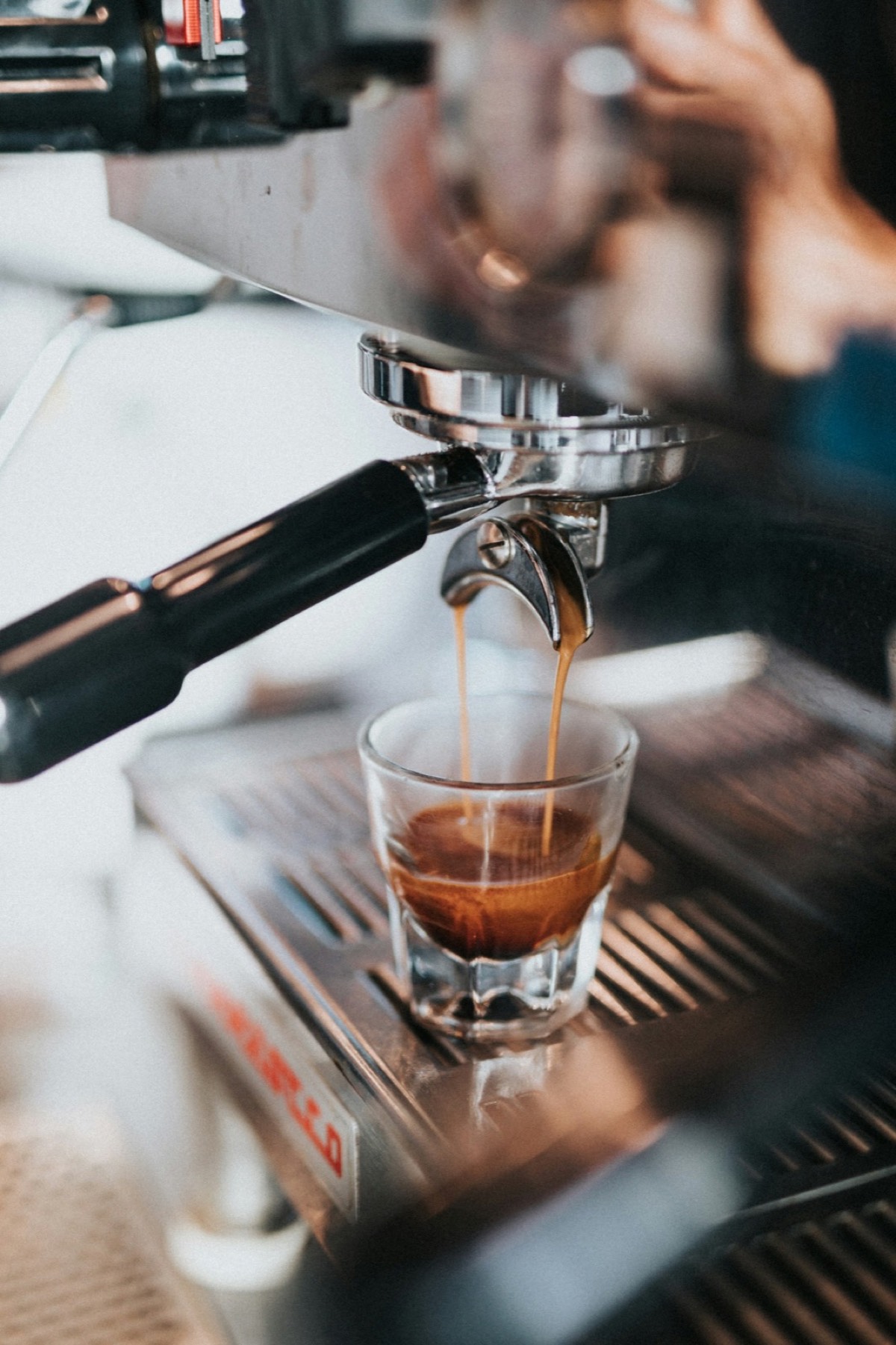
Breville's pages put both figures side by side, which makes the distinction easy to see. The Dual Boiler is described as "low pressure pre-infusion followed by a high pressure (9 bar) extraction ... delivered via our 15 bar Italian pump" [1]. The Bambino repeats the same pairing: a 15 bar Italian pump, extraction at 9 bar [2].
Read as a spec, the 15 bar number is the pump's ceiling, not the pressure your coffee sees. Pre-infusion begins lower on purpose, then the machine holds roughly 9 bar through the shot [1][2]. When you compare machines, the meaningful question is whether the machine can hold its brew pressure steady — which is what the pressure gauge on the front panel is there to show [1].
What the same pages do not say is which kind of pump sits inside. None of those pages names the pump type; they give the pressure rating and stop there. That makes pump construction — vibratory versus rotary — a line to look up separately or ask about before buying, and a spec sheet that does not state it has not told you.
Temperature Control: Thermostats, PID, and What Adjustability Buys You
Temperature control is the second spec that separates machines. A thermostat simply switches a heater on and off; a PID controller measures the boiler and holds it at a set value.
Breville lists PID control on the Dual Boiler's espresso boiler and a heated group head on the same machine [1]. La Marzocco describes the Linea Mini as having a built-in PID system with an integrated group head [3], and the Linea Micra as "double-boilers, PID, and full temperature control" [4].
Practically, the spec tells you one thing you can act on: whether the brew temperature is a fixed property of the machine or a value you can change. If you switch beans and roast levels often, a machine with an adjustable set point lets you follow the coffee. If you drink the same beans from the same roaster, a fixed temperature is not a limitation — it is simply one less variable to think about.
Warm-Up Time, Water Capacity and Power
Warm-up is where the spec sheets thin out. The on-demand machine in this comparison publishes the clearest number: 3 seconds to be ready to start, with a manufacturer benchmark claiming up to 32% less energy annually than a Thermoblock heating system [2]. That benchmark is Breville's own internal test, dated November 2022, and the page labels it as such [2].
The boiler machines listed here publish volumes and power rather than minutes. The Linea Micra states 1600 W at 110 V, 42 lbs and a 1.6 L steam boiler [4]; the Linea Mini lists 1620 W, 14 A at 115 V, 66 lbs, a 3 L steam boiler and a 2.5 L water reservoir [3]. Breville publishes the Dual Boiler's footprint as 37.9 × 40.3 × 37.1 cm [1]. If warm-up minutes matter to you and the product page does not give them, that number has to come from the instruction manual or the seller — it is not something to estimate from wattage.
How to Choose by Daily Cups and Back-to-Back Drinks
Work down this list and stop at the first line that matches your routine. The criteria are countable, so you can settle it before you open a product page.
- Count the milk drinks you make in a row. If the answer is zero or one, you never need a machine to brew and steam at the same time, and an on-demand heater is enough — 3 seconds to ready, 54 mm basket, 18 g dose, $299.95 as listed [2].
- If you steam after nearly every shot and dislike waiting, you need simultaneous brew and steam. That is a dual-boiler spec, stated directly on the Breville page [1], listed at $1,599.95 [1].
- If you make four or more drinks back to back, size the steam boiler rather than the pump. Compare published volumes: 1.6 L on the Linea Micra [4] against 3 L on the Linea Mini [3]. A larger steam boiler recovers between pitchers, which is the difference between a steady rhythm and standing around.
- Check the refill interval against your water. Published reservoir capacity is 2.5 L on the Linea Mini [3]. Multiply your daily volume by the days you want between refills, and pick a machine that clears it.
- Check the dose you actually use against the listed baskets. Published options include 7 g, 14 g, 17 g and 21 g on the Linea Mini [3], a 22 g dose in a 58 mm basket on the Dual Boiler [1], and an 18 g dose in a 54 mm basket on the Bambino [2].
- Check the footprint and weight last. The Linea Micra lists 42 lbs [4] against 66 lbs for the Linea Mini [3]; the Dual Boiler lists 37.9 × 40.3 × 37.1 cm [1]. Counter depth and cupboard clearance are fixed, and no boiler type changes them.
A machine that clears every line above in your routine is the one to buy. A machine that fails line 1 or line 3 will keep failing it, whatever the price tag says.
The short version
Read four lines before anything else: boiler setup, the difference between the pump's rating and the brew pressure, whether the brew temperature is PID-controlled and adjustable, and the published water capacity. Then match them to how many drinks you make in a row and how often you want to refill. Each figure above is a value from a manufacturer product page, dated where that page appears in the list below, and the same pages are the fastest way to confirm a number that matters to you before you buy.
Method: This page compares home espresso machines from the manufacturers' published product pages listed at the end, reading boiler setup, pump rating, temperature control, warm-up behaviour, water capacity and price line by line from those pages.
Boundary: A product page states what a machine is built to do — heat water to a set point, hold a brew pressure, carry a water tank — so its figures describe the design of the machine. What arrives in the cup is also decided by the grinder, the coffee and the dose in the basket.
- Breville — the Dual Boiler (US product page)accessed 2026-09-11
- Breville — the Bambino (US product page)accessed 2026-09-11
- La Marzocco Home — Linea Mini (product page and technical specifications)accessed 2026-09-11
- La Marzocco Home — Linea Micra (product page and technical specifications)accessed 2026-09-11
Price lines are whatever those pages showed at the time of checking and vary with promotions.