The paper filter is the part of a pour-over you throw away, which makes it easy to treat as packaging. It is not. The sheet of paper is a flow resistor sitting between the water and the cup, and changing it changes dwell time first, then extraction, then flavour — in that order.
Read the filter that way and the choice between a cone, a flat basket and a thick filter stops being a matter of taste. Each format sets a different bed geometry, each grade of paper adds a different amount of resistance, and the numbers that move as a result are the same ones you would measure in any other part of the brew.
A filter is a flow resistor before it is a flavour choice
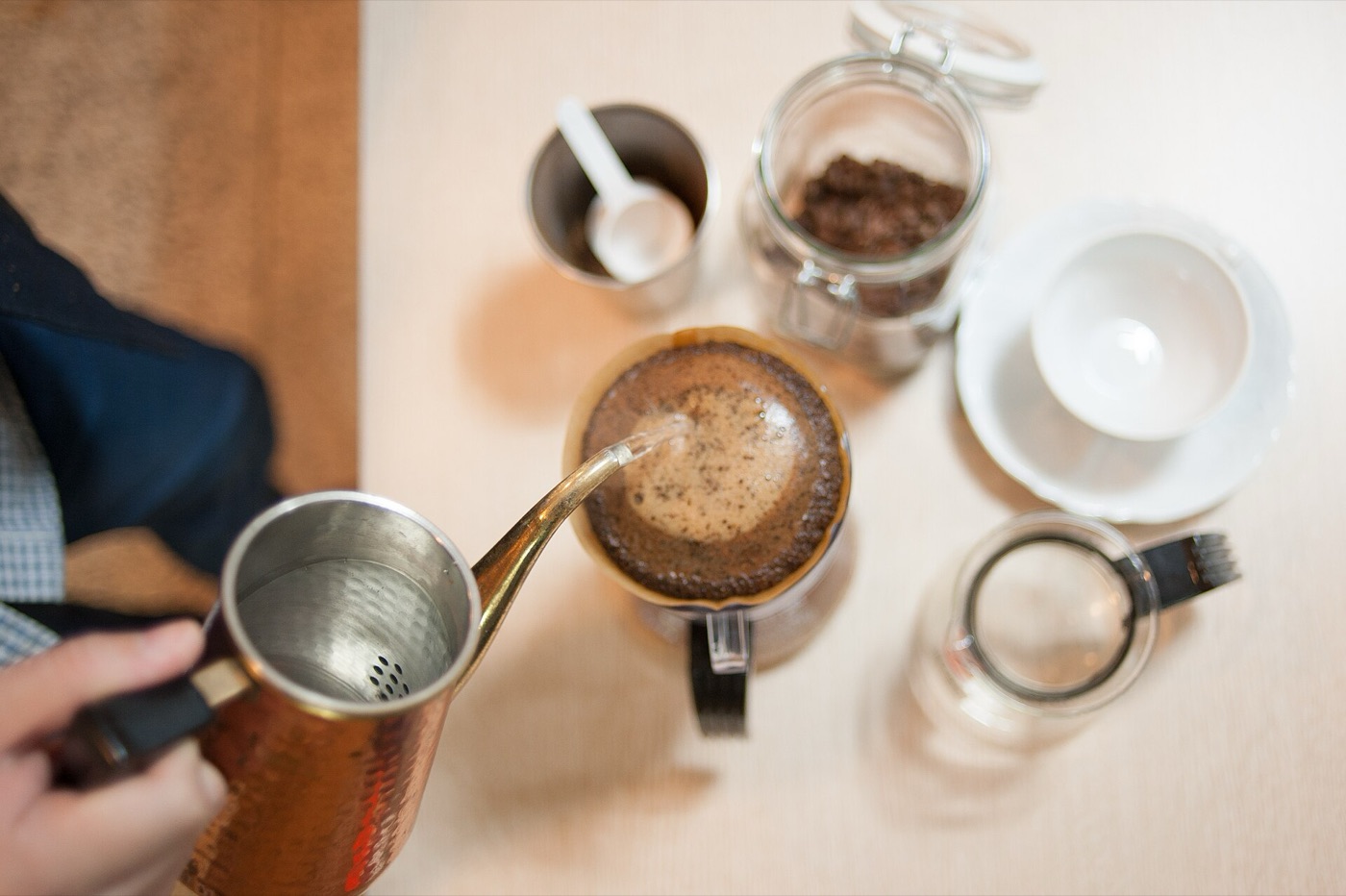
In a published V60 protocol the brew runs at a 1:15 ratio with 93 °C water [1]. Those two figures are the frame: the water has to travel through the coffee bed and then through the paper, and both layers resist it. The coffee bed dominates when the grind is fine, because a finer bed has more surface area and less space between particles for water to move through. The paper dominates when the bed is coarse and thin, because the water arrives at the sheet faster than it can pass.
The particles a filter is meant to stop are the small ones. Every grinder produces a fines fraction — particles below roughly 100 µm — and in measured extraction work the fines share, not the average particle size, is the variable that sets how fast the bed empties [2]. A filter that traps more of those fines slows the brew and changes what the liquid carries; a filter that lets them through speeds the drawdown and puts them in the cup.
Cone, flat and cake: where the water actually travels
Filter format decides the shape of the bed, and the bed shape decides the path the water takes. A cone holds grounds in a deep, tapering pile, so the water column is tallest at the centre and the liquor drains toward a single outlet at the bottom. A flat-bottom basket spreads the same dose across a wider, shallower bed with several outlets, which shortens the distance any one path has to travel. A cake-style flat filter adds a restricted set of holes under the paper, which resists flow at the outlet rather than at the walls.
Modelling work on porous coffee beds shows that extraction uniformity depends on how evenly the water moves through the bed rather than on the average residence time alone, which is the mechanism behind the practical observation that conical and flat brewers at the same ratio do not deliver the same cup [3]. Grind class then has to be chosen for the geometry: pour-over beds are built around medium-fine coffee, roughly 600–800 µm, while a press or a very deep bed wants the coarse band at 800 µm and above [4].
Bed depth sits behind the shape differences. A deep cone holds a taller column of coffee, so water spends longer in the upper layers before it reaches the tip; a shallow flat bed shortens that column and evens out the path [5]. Neither geometry wins outright, which is why each one asks for a slightly different grind before it settles into the same working range.
What paper keeps out of the cup
The mechanical difference between paper and metal is particle retention, and one consequence is measurable in the chemistry of the brew. An analysis of coffees prepared by different methods found substantially higher levels of the diterpenes cafestol and kahweol in metal-filtered and boiled preparations than in paper-filtered ones [5]. Paper traps a large share of the oil droplets that carry those compounds; a mesh does not.
Caffeine is different. A study measuring the composition of brewed beverages reported 185.48 mg of caffeine in a 250 mL V60 brew, against 195.90 mg in a 250 mL simple infusion and 206.88 mg in a 250 mL French press brew [6]. The filter medium is only part of what separates those numbers — contact pattern and serving construction differ across those brews — but the direction is consistent with what filtration does: paper leaves more of the dispersed material behind, so the liquid that reaches the cup is cleaner and often reads thinner in body.
The sensory side of that shows up in immersion too. Full-immersion brewing produces a cup that is measurably less bitter, less sour and more floral than a hot filtered brew of the same coffee, which is the direction you move when the filter stops holding back oils and fines [7].
Thickness, bleaching and the papery note
Paper grade changes resistance, and bleaching changes the paper itself. Oxygen-bleached and elemental-chlorine-free papers are produced without chlorine gas bleaching, while unbleached papers keep more of the lignin that gives wood pulp its natural colour. Lignin-bearing paper is stiffer and, in the cup, more likely to contribute a papery note if the filter is not rinsed before the brew.
Two numbers keep the choice in proportion. The particles the paper has to retain are the fines below about 100 µm, so a heavier sheet buys slower flow rather than a categorically different filter [2]. Nor does the paper move the brewing range: whichever sheet sits in the cone, water temperature for coffee is 92–96 °C [8], and the ratio you wrote down before you started stays where you put it. Changing paper is a flow adjustment inside a fixed recipe, not a new recipe.
Rinsing is worth the thirty seconds for any grade. It warms the brewer, seats the paper against the cone wall so water cannot bypass the bed, and washes out loose fibre before the coffee arrives. A filter that is not seated flush lets the water run around the outside of the bed, which shortens contact time and leaves the outer edge of the coffee under-extracted.
The paper note a dry sheet can carry into the cup is the other reason to pour the rinse: about half a minute and one kettle of water decide whether the paper is something you notice in the drink [1].
Matching the filter to the grind and the dose
The workable rule is to pick the grind class that keeps the total brew inside the working time band for the format you own, rather than the class printed on a bag. The table below pairs the common paper formats with the particle-size band that suits them and a working ratio band for each. The particle-size classes come from the cited classification work; the ratio column is a working convention drawn from the single ratios quoted in the cited protocols, not a published standard [1][4].
| Paper format | Bed shape | Grind class that suits it | Working ratio |
|---|---|---|---|
| Cone (V60-style, one outlet) | deep, tapered | medium-fine, 600–800 µm | 1:15–1:16 |
| Flat-bottom basket (multiple outlets) | shallow, wide | medium, 600–800 µm | 1:15–1:17 |
| Thick-paper cone (Chemex-style) | deep, heavy sheet | medium-coarse, 800 µm and above | 1:15–1:16 |
Two failure modes follow from that table. Pair a medium-fine grind with a heavy sheet and the brew stalls, because both the bed and the paper are resisting flow at the same time; the fix is one grind step coarser rather than a faster pour. Pair a coarse grind with a thin, fast paper and the water runs through before it has taken much out of the grounds; the fix is finer coffee or a slower pour, not a longer bloom.
A filter change you can measure in one brew
To find out what a new paper does to your recipe, hold everything else constant. Keep the dose, the ratio, the grind and the water temperature identical, swap only the filter, and log the total brew time. Published protocols steep for three to five minutes across the various filter methods, so a change that pushes your brew outside the band you have been hitting is the paper talking rather than the coffee [4]. One brew with one variable changed tells you more than three brews with a new grinder setting and a new filter at once.
After that, the sheet is a routine cost rather than a decision point. Match the size code to the brewer so the paper seats without folding, keep one grade in the cupboard, and treat a switch in format as a deliberate change to the bed geometry — because that, mechanically, is what it is.
Method: The filter comparisons on this page come from the brewing studies listed at the end — measured flow and retention behaviour, particle-size classes, temperature ranges and the measured composition of filtered versus unfiltered brews.
Boundary: The page covers paper filtration for gravity brewers: what shape, thickness and paper chemistry change in flow and in the cup. The coffee and the brewer model set the rest of the recipe.
- Discrimination of Filter Coffee Extraction Methods of a Medium Roasted Specialty Coffee Based on Volatile Profiles and Sensorial Traits, Foods 12(17):3199, 2023accessed 2026-09-11
- The role of fines in espresso extraction dynamics, Scientific Reports 14:5555, 2024accessed 2026-09-11
- Analysing extraction uniformity from porous coffee beds using mathematical modelling and computational fluid dynamics approaches, PLOS ONE 14(7):e0219906, 2019accessed 2026-09-11
- Does Coffee Have Terroir and How Should It Be Assessed?, Foods 11(13):1907, 2022accessed 2026-09-11
- Gross G, Jaccaud E, Huggett AC — Analysis of the content of the diterpenes cafestol and kahweol in coffee brews, Food and Chemical Toxicology 35(6), 1997accessed 2026-09-11
- Influence of Brewing Methods on the Bioactive and Mineral Composition of Coffee Beverages, Molecules 30(20):4080, 2025accessed 2026-09-11
- Sensory Analysis of Full Immersion Coffee: Cold Brew Is More Floral, and Less Bitter, Sour, and Rubbery Than Hot Brew, Foods 11(16):2440, 2022accessed 2026-09-11
- Batali ME, Ristenpart WD, Guinard J-X — Brew temperature, at fixed brew strength and extraction, has little impact on the sensory profile of drip brew coffee, Scientific Reports 10:16450, 2020; quotes the SCA Coffee Brewing Handbook range of 92–96 °C for brewing wateraccessed 2026-09-12
If you change one thing on this page, change the grind class with the format. The paper sets how fast the water can leave; the grind sets how much there is for it to take with it. Get the pair right and the filter stops being a variable you notice, and a sheet of paper returns to being what it is: a controlled resistance at the bottom of the bed.