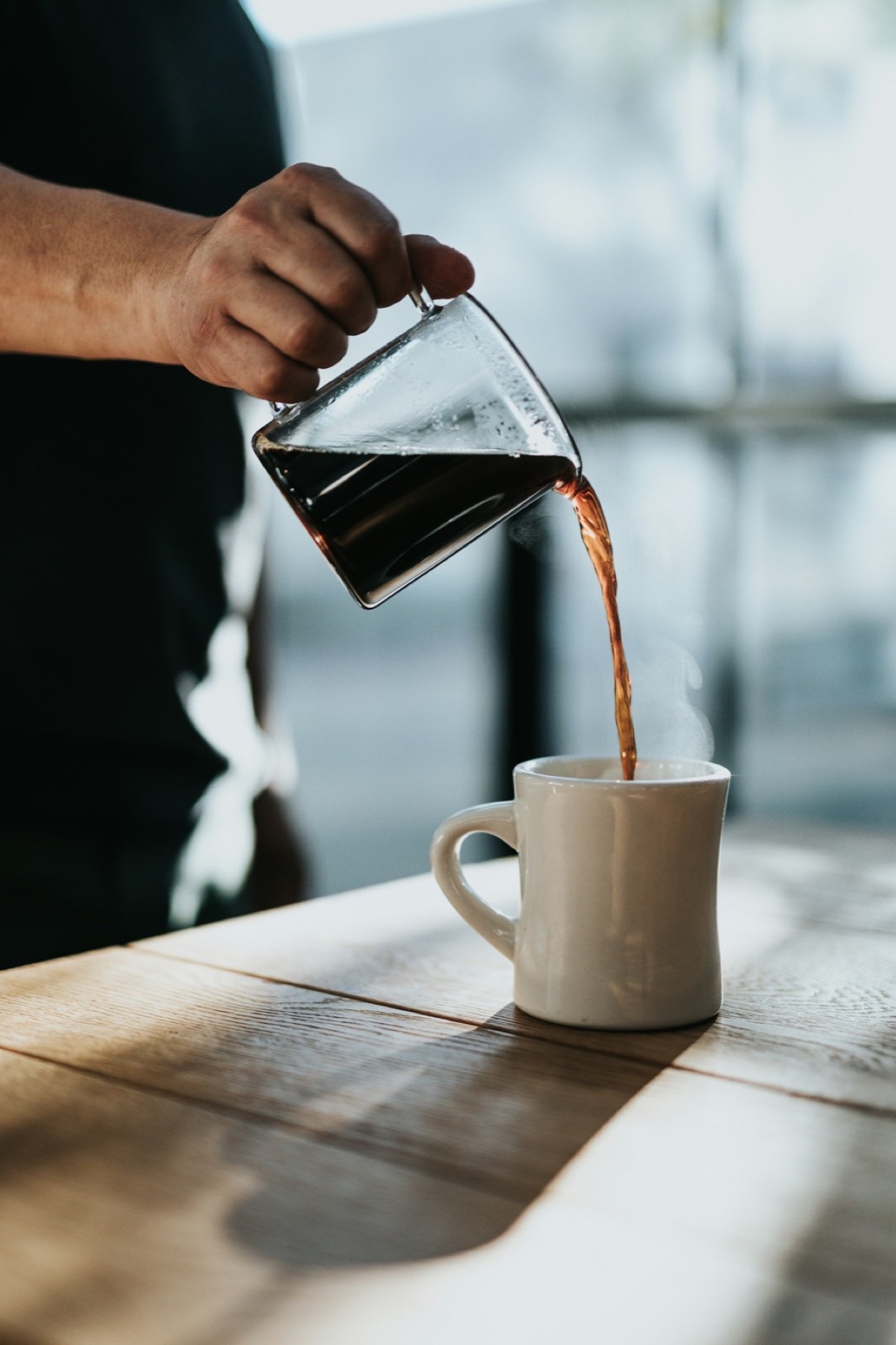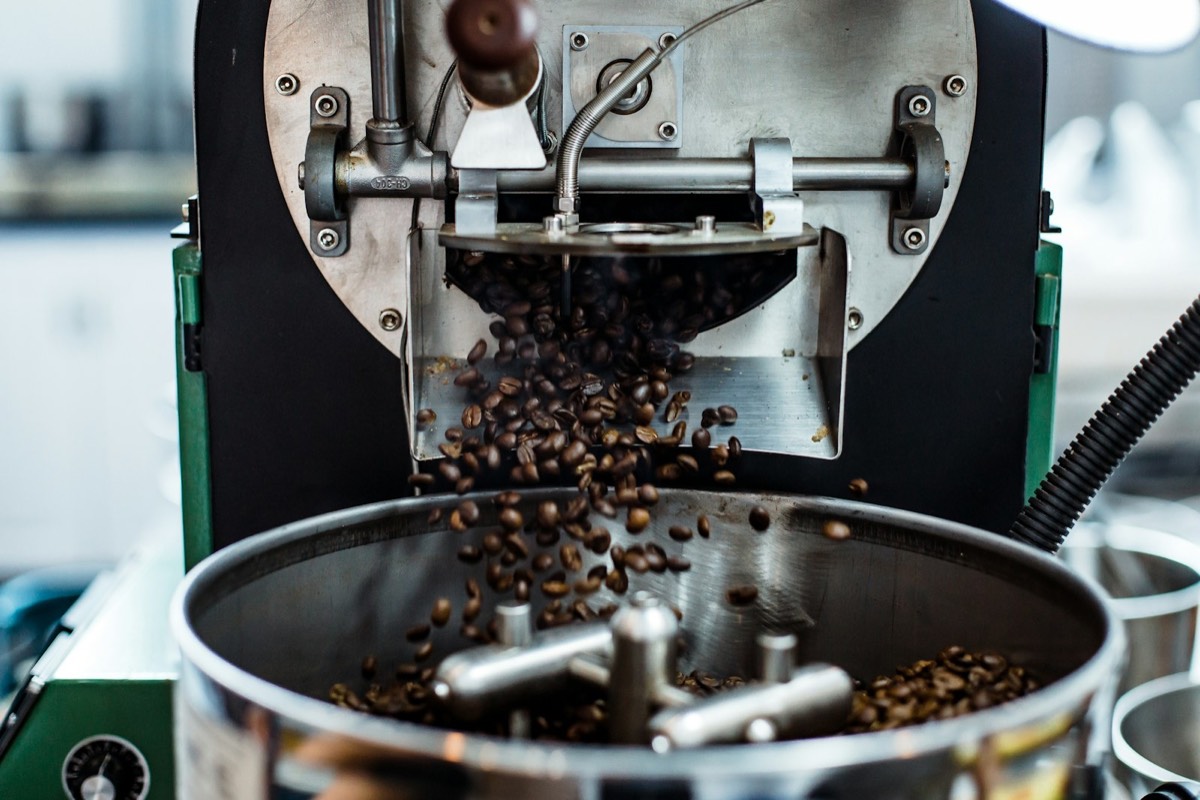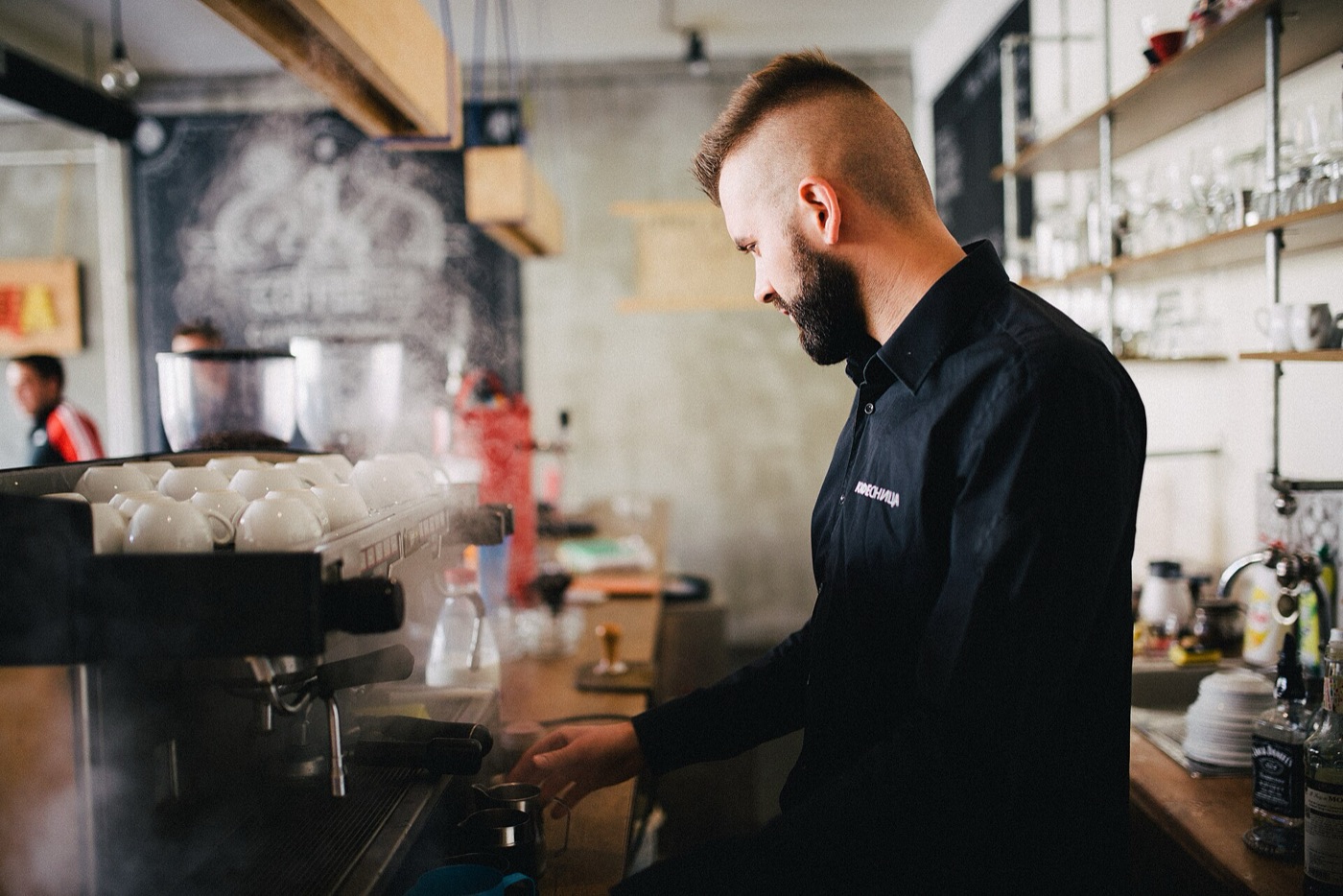
Cleaning an espresso machine is three jobs sharing one bench. Coffee oil collects on the coffee side — basket, shower screen, group, drip tray. Mineral scale collects on the water side — boiler, thermoblock, valves. Milk residue collects on the steam side, and it sets faster than either of the others because it is being cooked while you work. Which of the three dominates your week is decided by the machine in front of you, not by the badge on it.
The published figures make that split visible. Breville lists its ThermoJet machines as ready to start in 3 seconds, from $299.95 for the Bambino and $499.95 for the Bambino Plus, both built around a 54 mm basket that takes an 18 g dose [1][2]. The Dual Boiler is listed at $1,599.95 with a PID-controlled espresso boiler, a separate steam boiler and a 58 mm basket that takes a 22 g dose [3]. La Marzocco publishes the volume behind that arrangement rather than only the label: 0.25 L for the coffee boiler and 1.6 L for the steam boiler on the Linea Micra [4]. Three machines, three surface lists, three schedules.
Three surfaces and the pressure that loads them
Espresso pushes water through a compacted bed at roughly 9 bar, and the basket and shower screen hold what that extraction leaves behind — an oil film that tastes stale long before it looks dirty. Breville states the same pairing on its entry machines and on the dual-boiler model: a 15 bar pump delivering a 9 bar extraction, with low-pressure pre-infusion ahead of it [1][2][3]. The Specialty Coffee Association's espresso-machine standard, SCA-350, is the published specification that covers semi-automatic and automatic espresso machines, which is the class every model on this page belongs to [5].
Scale is a different deposit with a different cause. Calcium carbonate comes out of the water itself, so the water side of the machine accumulates material whether or not you ever pull a shot: it forms in the boiler, on the heating element and around the valves. Boiler volume is the number that decides how much of the machine is holding that water. On the Micra the steam boiler and the coffee boiler stand at 1.6 L and 0.25 L — better than six to one [4] — and the Linea Mini carries a 3 L steam boiler with a 2.5 L reservoir [6]; every one of those volumes is a wetted surface that a descale has to reach.
Milk is the third deposit, and it is the one with a clock on it. Breville lists the Bambino Plus steam wand at 266 °F (130 °C), with three milk temperatures and three texture levels [2]. Milk left on a tip at that temperature does not simply dry; it cooks into the small opening the steam has to pass through, which is why the wipe belongs in the same minute as the pour, not in the evening clean-up.
The coffee side: rinse daily, backflush where a disc is listed
Everything the coffee touches comes off the machine in seconds: knock the puck, rinse the basket under the group, wipe the shower screen, empty the drip tray. That step needs no consumables and no cycle, and the larger basket — 58 mm against 54 mm, 22 g against 18 g — holds more spent grounds and more oil per shot, so it takes proportionally longer to rinse clean [1][2][3].
Backflushing is the part of the routine that depends on what shipped in the box. A blind disc or cleaning disc blocks the basket outlet, so water is forced back up through the group instead of down into a cup; Breville lists a cleaning tool and a cleaning disc among the accessories of the Bambino Plus, and a cleaning kit with the Dual Boiler [2][3]. Machines without that hardware get no benefit from the step, and machines that have it also carry a second job in the same cycle: a detergent backflush lifts the oil film that rinsing leaves on the group, and a water-only backflush afterward clears the detergent.
Why the shower screen matters more than its size suggests is a particle question, and a 2024 study of fines in espresso extraction dynamics supplies the mechanism: a dose's sub-100 µm share, not its median size, is what moves shot time [7]. A screen holding old oil and lodged fines is therefore a flow restriction inside a system that is already sensitive to how finely the coffee was cut, and the same coffee at the same grinder setting can drift simply because the screen was not wiped.
The water side: the hardness reading sets the clock
Descalings are not scheduled by the calendar so much as by the water. Breville ships a water hardness test strip with the Dual Boiler and with the Precision Brewer, the two machines in this comparison whose pages state it [3][8], and the strip exists precisely because two households pulling the same number of shots can be at opposite ends of the descale interval on identical hardware.
The volume that has to be treated scales with boiler capacity. On the Micra the brew side is the small vessel at 0.25 L, exchanged often, while the steam side holds 1.6 L standing at temperature; the Mini's far larger steam side sits at 3 L, with a 2.5 L reservoir behind it [4][6]. A drip brewer sits at the same order of magnitude: the Precision Brewer's tank is 60 oz, or about 1.8 L, and the Moccamaster KBGV Select brews a 1.25 L batch [8][9]. The practical consequence is that the machine with more standing water gives scale more surface to sit on, and the machine whose page hands you a hardness strip gives you a reading to act on instead of a guess.
The steam side: a job measured in seconds
Steam is where cleaning turns into maintenance. The Bambino Plus automates the purge — the wand's listed steam temperature is 266 °F (130 °C), and it carries three milk temperatures and three texture levels [2] — so the work it leaves you is a wipe of the tip and a short purge to clear the opening. A manual wand such as the Bambino's asks for the same purge by hand after every jug [1]. The number to watch is the steam temperature: at 130 °C, milk solids that stay on the tip are being held well above the point at which they set, and a blocked tip is not a slow pour but a stopped one.
There is also a parts question behind the steam side. Those entry machines are sold on their heater's speed — the 3 seconds Breville's ThermoJet design reaches — and the Bambino page also carries a manufacturer benchmark claiming up to 32% less energy annually than a Thermoblock heating system, dated November 2022 [1]. Boiler machines reach temperature more slowly but hold a large body of steam ready to go, which is what makes simultaneous brewing and steaming possible on the Dual Boiler [3]. A wand that is always ready gets used more often, and the more often it is used, the more the wipe matters.
Machine class against cleaning surface
| As listed | Bambino (BES450) | Bambino Plus (BES500) | Dual Boiler (BES920) | Linea Micra |
|---|---|---|---|---|
| Listed price | $299.95 [1] | $499.95 [2] | $1,599.95 [3] | $4,500 [4] |
| Portafilter and dose | 54 mm, 18 g [1] | 54 mm, 18 g [2] | 58 mm, 22 g [3] | baskets at 14 g and 17 g; 58 mm tampers [4] |
| Pump and brew pressure | 15 bar pump, 9 bar extraction [1] | 15 bar pump, 9 bar extraction [2] | 15 bar pump, 9 bar extraction, pressure gauge [3] | PID brew control; brew pressure not stated [4] |
| Heat-up stated | 3 seconds [1] | 3 seconds [2] | boiler machine [3] | boiler machine, 1600 W at 110 V [4] |
| Boiler or water volume | on-demand heating [1] | on-demand heating [2] | separate brew and steam boilers [3] | 0.25 L coffee boiler, 1.6 L steam boiler [4] |
| Cleaning parts listed with the machine | cleaning tool [1] | cleaning tool, cleaning disc [2] | cleaning kit, water hardness test strip [3] | Purocaf cleaning solution supplied [4] |
| Steam cleanup | manual wand [1] | automatic wand, 266 °F / 130 °C [2] | simultaneous brew and steam [3] | steam boiler with PID control [4] |
Read the table as a list of obligations rather than a ranking. The two on-demand machines ask for a manual purge and a fast wipe; the two boiler machines ask for the same wipe plus a water-side schedule that their own hardness readings set. Every row above is a published figure, which means the cleaning work can be counted before the machine reaches the counter.
Ordering the week around the parts you own
Start with the fastest surface and work outward. After every shot: knock the puck, rinse the basket and wipe the screen, because the basket meets fresh oil at every 9 bar shot [1][2][3]. After every milk drink: purge and wipe the tip before the residue can set at 130 °C [2]. Once a week, use the disc or kit that the machine shipped with, if it shipped with one, and follow it with a water-only cycle [2][3]. Then descale on the reading — the strip is the schedule [3][8].
The order matters more than the frequency, because each step protects the next. A rinsed basket keeps the backflush from spreading old oil into the group, and a descaled boiler holds its brew temperature more evenly, which is the property a PID espresso boiler is sold on [3]. None of this work needs a new part; it needs a machine whose accessories you have actually read. The cheapest consistency upgrade in espresso is not a device but the sequence you already own the tools for.
Method: This page groups espresso cleaning work by machine class using manufacturers' published product pages — heater type, listed price, portafilter and dose, stated pressure and steam figures, boiler volumes and the cleaning accessories each page names — alongside the Specialty Coffee Association espresso-machine standard and the peer-reviewed study of fines behaviour listed at the end.
Boundary: The figures describe the machines as they are built and sold, and the routine follows that hardware rather than a single brand's instruction sheet, so the surfaces and cycles line up with the heater, basket and boiler a machine actually carries. Where a page does not state a figure — descale interval, warranty, or the parts bundled with a machine — that row is marked as unstated rather than filled in.
- Breville — the Bambino (BES450) espresso machine (listed at $299.95; 54 mm basket, 18 g dose)accessed 2026-09-12
- Breville — the Bambino Plus (BES500) espresso machine (listed at $499.95; 54 mm basket, 18 g dose, 266 °F steam)accessed 2026-09-12
- Breville — the Dual Boiler (BES920) espresso machine (listed at $1,599.95; 58 mm basket, 22 g dose, cleaning kit and water hardness test strip)accessed 2026-09-12
- La Marzocco Home — Linea Micra product page and technical specifications (0.25 L coffee boiler, 1.6 L steam boiler, 1600 W at 110 V, 42 lb, baskets at 14 g and 17 g, $4,500; brew pressure not stated)accessed 2026-09-12
- Specialty Coffee Association — Coffee Standards (SCA-350, semi-automatic and automatic espresso machines)accessed 2026-09-12
- La Marzocco Home — Linea Mini product page and technical specificationsaccessed 2026-09-12
- The role of fines in espresso extraction dynamics. Scientific Reports (2024). doi:10.1038/s41598-024-55831-xaccessed 2026-09-11
- Breville — the Precision Brewer (BDC400) coffee maker (60 oz tank, water hardness test strip; now marked discontinued)accessed 2026-09-12
- Moccamaster — KBGV Select brewer (1.25 L / 40 oz batch)accessed 2026-09-12
The source types divide deliberately here: brand product pages carry the prices, basket sizes, boiler volumes and steam ratings, while one association standard and one peer-reviewed study carry the pressure and particle behaviour that explain why each surface needs attention in the first place.