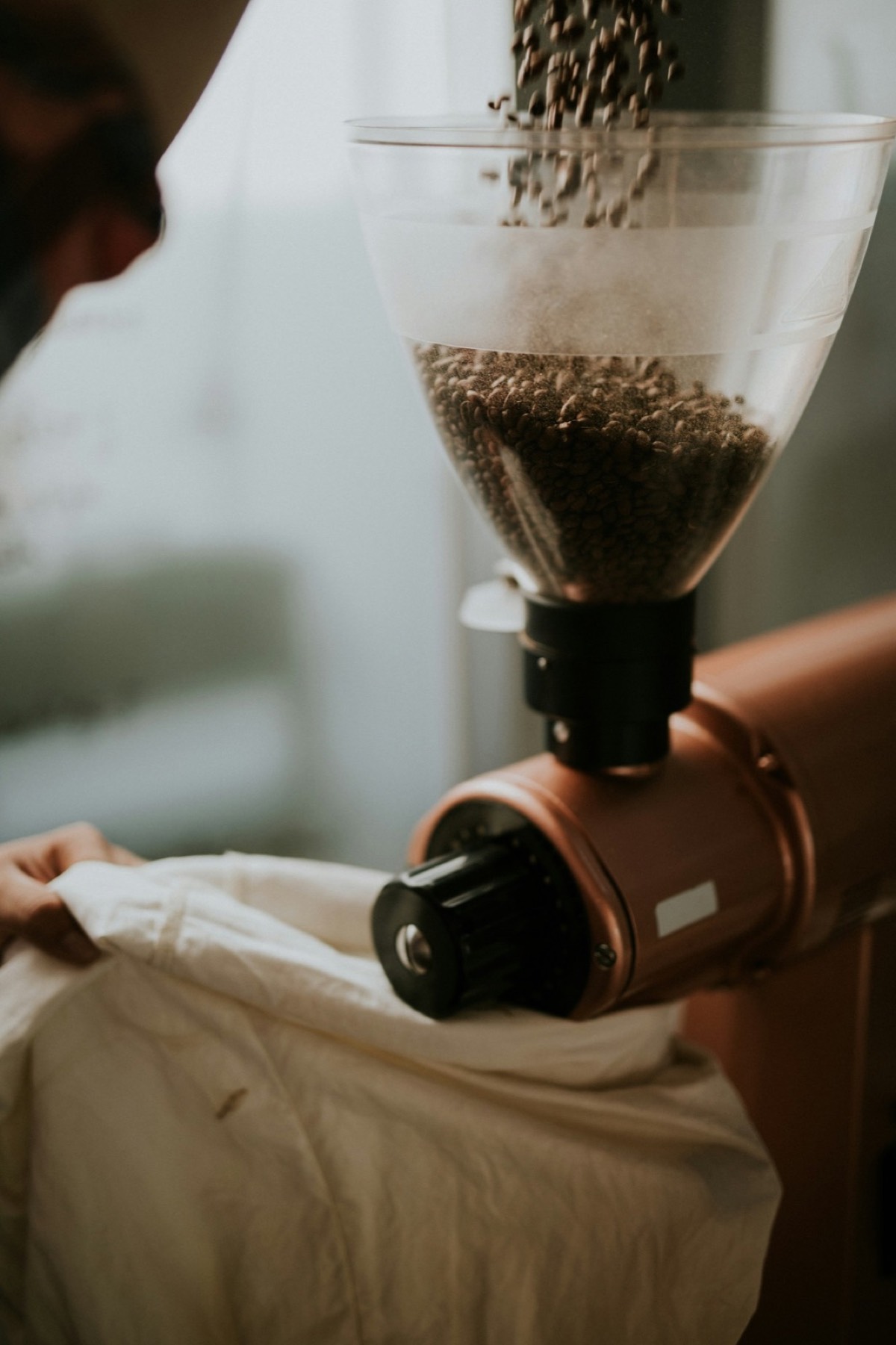
A hand grinder is the one piece of coffee gear where the entry level and the top of the range share the same working principle: steel burrs, a shaft, bearings and a crank. What separates the models is how much cutting surface you get, how finely the dial resolves a change, and how many grams fit per fill. Those three questions are answerable from published product data, and the answers cost between $89 and $349 across the models cited here [1][3].
The map below covers hand grinders whose makers publish their burr size, dial and capacity. Every dollar figure is the maker's own listed price on the access date; sales, shipping and regional taxes sit outside it. Where a maker does not publish a figure — net weight, for instance — that gap is written down instead of estimated.
Where the entry level starts for a hand grinder
The cheapest complete grinder in this set is Timemore's Chestnut C3 at $89 [1]. One step up, Kinu's M47 Phoenix lists at $219 and the M47 Classic at $349 [2][3]. The Comandante C40 MK4 Nitro Blade sits above them, at a price its maker does not publish on the page cited [5]. Across the four counter-top models that share a burr-and-body format, the listed prices run from $89 to $349 — a 3.9-fold spread; the Kinu M68 tabletop model is a different class of machine, a 68 mm conical grinder listed at $1,199 on the access date [4].
What the spread buys is not a different mechanism. It buys cutting surface, resolution and mass, in varying proportions, and the proportions differ by maker. Kinu's two models share the same 47 mm conical burr set and the same 40 g capacity, and are separated mainly by body and finish, with the Classic listed at 1175 g against the Phoenix at 780 g [2][3]. The C40's own differentiator is the burr material and the two bean jars supplied with the grinder [5].
Burr size and material at this level
Published burr diameter runs to 47 mm across the models whose makers state it. The C3's burr set is described by its maker, who publishes the standard 20 g catch cup and an optional 30 g XL cup rather than a burr diameter [1]. The Kinu M47 models carry a 47 mm conical set [2][3], and the C40 is built around the maker's Nitro Rex steel burr set [5].
Diameter sets the length of the cutting path, so a bigger set clears a given dose with fewer turns and tolerates back-to-back cups without the setting drifting. It does not, on its own, decide the spread of particle sizes. A published experiment that reground one coffee at several bean temperatures and from several origins recorded a different distribution of particle sizes for each run, which places part of the outcome in how the burrs are loaded rather than in their diameter alone [6]. In espresso, the number to watch is the fraction of the dose finer than 100 µm, since that fraction tracks total shot duration more closely than the mean particle size does [7]. Filter and press brewing sit further up the scale, in the medium and coarse classes above 600 µm [8].
Dial resolution, per click and per band
The C3's grind dial is sold without a published click count, so the useful comparison is the size of one step inside the band you brew [1]. The Kinu M47 models adjust on the maker's own collar, and the C40 uses a click system of its own [2][3][5]. A click count is a total, not a resolution: what a click changes at the fine end of the range is what matters for espresso, and what it changes at the coarse end matters for press and filter brewing.
Two practical readings follow. First, compare clicks inside the class you brew rather than across the whole dial, because the same travel is spread over coarse press settings and over a much narrower espresso range. Second, weigh how quickly the setting returns after the dial has been turned — that is a manufacturing question, and the published proxy is the service commitment: Kinu prints a five-year term on its grinders [2][3]. A grinder that comes back to the same setting in the same number of clicks is the one that lets you change a single variable at a time.
Grams per fill, and what a fill covers
Capacity on a hand grinder is the catch cup or jar, not a hopper, so it reads directly as a dose count. On the C3, the standard cup takes 20 g and an XL cup takes 30 g, so one fill is enough for a big single brew or for a pair of small cups [1]. The Kinu M47 models state 40 g, which is two mugs or a small pot before a refill [2][3]. The C40 is supplied with two bean jars [5].
Read against a morning rather than a spec sheet: a 20 g fill leaves nothing spare after a single 18–20 g dose, a 30 g cup leaves room for a top-up, and a household that brews two 20 g filter doses back to back is asking a 20 g cup to work twice — which is where the 40 g bodies earn their price.
Weight, travel and the counter
Mass separates the entry models more than the burr does. The M47 Phoenix is listed at 780 g and the M47 Classic at 1175 g [2][3]. The M68 tabletop model in the same hand-grinder line is built to stay on a counter around a 68 mm set, while the 780 g body is the one that goes into a bag; the maker does not publish the M68's weight on the page cited [4].
A hand grinder has no motor, switch or gearbox to wear, and no mains lead, which is the whole reason the category exists. The parts that can need replacing are the burrs and the bearings, and the published answer to how long a maker expects to support a unit is the warranty it prints: five years across Kinu's grinders in this set [2][3].
The listed prices side by side
Every figure below is the maker's published listing, quoted on the day the page was checked.
| Model | Burr | Dose per fill | Weight | Listed price |
|---|---|---|---|---|
| Timemore Chestnut C3 | Not published [1] | 20 g cup, with a 30 g XL option [1] | Not published | $89 [1] |
| Kinu M47 Phoenix | 47 mm conical [2] | 40 g [2] | 780 g [2] | $219 [2] |
| Comandante C40 MK4 Nitro Blade | Nitro Rex steel burr set [5] | Two bean jars supplied [5] | Not published | Not published [5] |
| Kinu M47 Classic | 47 mm conical [3] | 40 g [3] | 1175 g [3] | $349 [3] |
| Kinu M68 tabletop | 68 mm conical [4] | Not published [4] | Not published [4] | $1,199 [4] |
For scale, an electric single-dose grinder with 64 mm flat burrs is listed at $449 at the same access date [9], which places the hand models below the single-dose flat-burr class.
Two checks that settle the model
Run these in order and the shortlist usually collapses to one entry.
- How much do you grind in one session, and how many sessions a day? One 18–20 g dose a day fits a 20 g cup with nothing spare; two doses back to back, or a small pot, needs the 40 g bodies; a household grinding 60 g in a morning is past what this group is built for [1][2][3].
- Which band will you dial most often? Espresso lives in the 300–600 µm fine band, where a dial with many small steps gives the smaller increment and the finer control; filter brewing in the 600–800 µm medium band is more forgiving of a coarser step [8].
Method: This page compares hand coffee grinders from the makers' published product pages listed at the end, reading burr diameter and material, dial and capacity, weight, warranty and listed price line by line from those pages, with the grinding research cited for the particle-size figures.
Boundary: A product page states what a grinder is built and sold as — burr diameter, catch-cup capacity, weight and warranty — so its figures describe design and capacity. Alignment, burr condition and the setting used also shape what a given unit produces.
- Timemore — Chestnut C3 product page (standard 20 g catch cup, optional 30 g XL cup, $89; the page does not publish a burr diameter or a click count)accessed 2026-09-12
- Kinu — M47 Phoenix product page (47 mm conical burrs, 780 g, 40 g capacity, sale price $219 on the access date against a regular price of $249, 5-year warranty)accessed 2026-09-12
- Kinu — M47 Classic product page (47 mm conical burrs, 1175 g, 40 g capacity, sale price $349 on the access date against a regular price of $399)accessed 2026-09-12
- Kinu — M68 tabletop hand grinder (68 mm conical burrs, stepless adjustment with up to 50 divisions per revolution; sale price $1,199 on the access date against a regular price of $1,299; weight and capacity not published)accessed 2026-09-12
- Comandante — C40 MK4 Nitro Blade BLACK (Nitro Rex steel burr set, supplied with two bean jars; no price is listed)accessed 2026-09-12
- Uman E, Colonna-Dashwood M, Colonna-Dashwood L, et al. — The effect of bean origin and temperature on grinding roasted coffee, Scientific Reports 6:24483 (2016) — particle-size distributions recorded after regrinding one coffeeaccessed 2026-09-11
- The role of fines in espresso extraction dynamics, Scientific Reports (2024), doi:10.1038/s41598-024-55831-x — the fraction of an espresso dose finer than 100 µmaccessed 2026-09-11
- Does Coffee Have Terroir and How Should It Be Assessed?, Foods (2022), doi:10.3390/foods11131907 — the SCA grind-class bands run fine at 300–600 µm and medium at 600–800 µmaccessed 2026-09-11
- DF64 Coffee — DF64 Gen 2 single-dose grinder (64 mm flat burrs, 250 W, sale price $449 on the access date against a regular price of $549)accessed 2026-09-12
- Seattle Coffee Gear — Baratza Encore (a shop listing; the grinder's burr size, step count, motor rating and hopper capacity are not published)accessed 2026-09-12
Dollar amounts are the makers' own listings when the pages were checked, and promotions or regional taxes move them; where a page shows a sale price and a regular price, the figure quoted is the one shown on the access date. Burr diameters, capacities and weights are reproduced as each maker states them, and figures the sources do not publish are marked as such rather than estimated.