Burr shape is the one grinder spec that survives every marketing page: conical or flat. Both crush coffee between steel surfaces, and both beat a blade grinder by a wide margin. What differs is the path the coffee takes, how much work each pass gets, and what the two designs cost at the level you are actually shopping.
Every figure below comes from makers' published product data, checked on 11 September 2026. The comparison table and the four checks at the end are built so you can settle the choice with numbers instead of adjectives.
How coffee moves through each shape
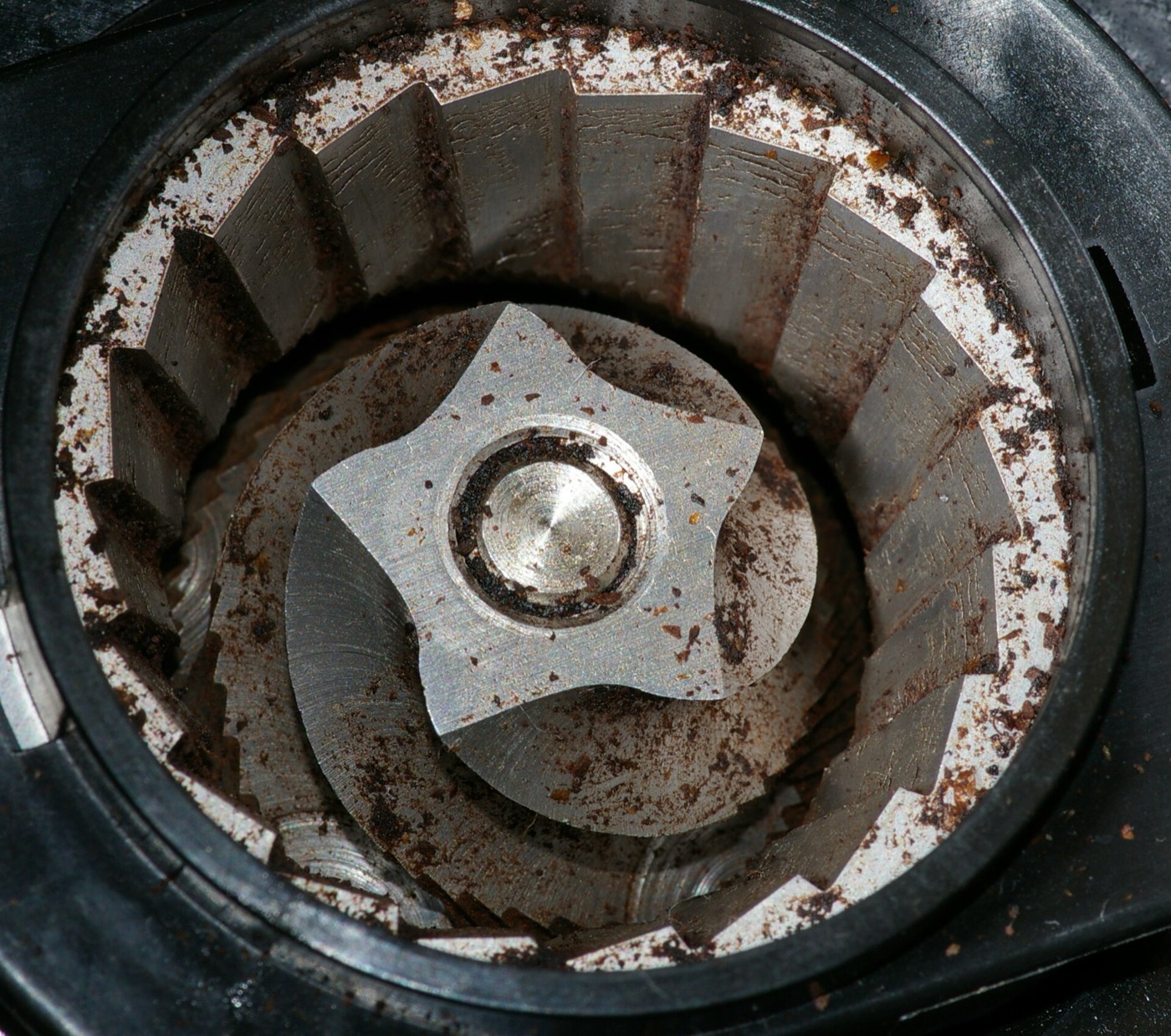
A conical set is a cone that turns inside a matching ring. Beans drop into a wide gap at the top and travel down a taper that narrows toward the bottom. Gravity does the feeding, and a particle leaves the burrs after one trip down the cone. That shape fits inside a narrow vertical body: the Niche Zero, listed as a "premium conical burr coffee grinder", is 4.1 kg in its own product data.
A flat set is two parallel discs. Coffee is fed into the space between them, then carried around the outer chamber by the rotation of the moving disc. A particle that is still too large stays in the chamber and comes around again, so a flat set works the dose harder per pass, and matching the throughput of a small cone asks for more diameter.
The practical difference is repeat passes. A cone sends the dose through once; a flat set keeps it in the cutting zone longer and gives the maker more room to change how the coffee is cut. That is why interchangeable burr sets are a flat-burr feature: Niche ships its flat-burr Duo with a choice of an espresso burr set or a filter burr set.
What the millimetre figure buys you
Burr diameter is the headline number on every grinder page, and on its own it measures capacity more than cup quality. Diameter sets the length of the cutting path and how much coffee the burrs can process in a second.
Niche's own product data shows the split cleanly. The Zero carries the model code NG63, a 63 mm-class conical set. The Duo carries the code ND83, and its product imagery names the set inside as an 83 mm Mazzer flat burr set — 20 mm more diameter, in the geometry that keeps the dose circulating.
More diameter is not automatically the better buy. A bigger set finishes a full dose faster and holds its setting across back-to-back cups, but it costs more, needs a larger housing to stay aligned, and takes up more counter space.
Particle spread, clarity, and body
Two grinders with the same diameter can still pour different cups, because the spread of particle sizes is set by geometry, the burr gap, the alignment of the discs or cone, and the material of the cutting surfaces.
Conical sets are sold for home espresso and all-round brewing, where a wider spread is the familiar working point: the finer particles help build resistance in the puck, and the coarser ones keep the shot from running thin. Flat sets are sold where definition is the goal, and the two burr sets on the Duo are the practical version of that idea — a filter set cut for a narrower band of particles at coarser settings, an espresso set for the fine end.
Whichever shape you choose, a grinder that repeats its setting from one morning to the next gives you more consistent cups than the shape on the box.
Published prices, side by side
Prices are the makers' own listed prices in the currency they publish, on 11 September 2026. Sales, regional taxes, and shipping move them, so confirm on the product page before ordering.
| Conical | Flat | |
|---|---|---|
| Geometry | Cone turning inside a ring; a single pass down a taper | Two parallel discs; the dose circulates for repeat passes |
| Published burr size | 63 mm-class set on the Niche Zero (model code NG63) | 83 mm Mazzer flat burr set on the Niche Duo (model code ND83) |
| Particle spread | Wider spread; the finer particles help build resistance in the puck | Narrower band at coarser settings with the filter set; fine end with the espresso set |
| Burr sets available | One set as shipped | Espresso set or filter set; both sets can be ordered |
| Published price | £559 | £649 with one burr set; £749 with both |
| Best fit | Single-dosing in a compact kitchen, espresso-forward brewing | Switching between espresso and filter, definition-first brewing |
Cleaning, wear, and the cost that comes back
Both shapes ask for the same three habits: brush out the chamber, clear the chute, and check the cutting surfaces for packed fines on a schedule that matches how much coffee you grind. A vertical cone sheds the dose by gravity, so there is less chamber to sweep; a flat set has a wider chamber around the discs and rewards a firm brush-out more often.
The long-run difference is what the burrs themselves cost to replace. Burr sets are a consumable part, and the price list shows how the maker treats them: the Duo is £649 with one burr set and £749 with both, so a second set adds about £100. If you plan to brew espresso and filter on the same grinder, buy that set with the machine rather than in year three.
Decision framework: four checks
Run them in order. Each one has a number or a yes/no answer, not a feeling.
- How much coffee do you grind a day? Up to 30 g, one or two cups — either geometry works, and a 63 mm-class conical set covers it. 60 g or more, or several cups back to back — the 83 mm-class flat set finishes a dose faster and holds its setting between cups.
- Do you brew espresso and filter on one grinder? Yes, and you are looking at the Duo — take the both-sets price of £749, not £649, so the filter set is part of the budget from day one.
- Is definition your first priority, or a rounder, heavier cup? Definition and clean separation point to the flat set; a rounded, forgiving cup points to the conical set.
- Where will it live, and what does it weigh? The Zero is 4.1 kg in a compact body, which suits a small counter and single-dosing. An 83 mm flat grinder is a bigger piece of furniture, and it needs the room to match.
Answer checks 1 and 2 with real numbers and the shortlist usually collapses to one machine. Checks 3 and 4 only break ties.
Method: This page compares conical and flat burr designs using the makers' published product data — model codes, burr sizes, listed prices and weights — together with the burr-geometry descriptions on the product pages listed at the end.
Boundary: Burr geometry and diameter are design parameters: they describe how coffee is fed into the burrs and cut, not how a finished dose tastes in the cup. In use, the particle spread from any grinder also depends on its alignment, burr condition and the setting it is dialled to.
- Niche Coffee — Niche Zero product data feed (model code NG63, £559, 4.1 kg, listed as a conical burr grinder)accessed 2026-09-11
- Niche Coffee — product data feed, Niche Duo (model code ND83, 83 mm Mazzer flat burr set, £649 with one burr set, £749 with both)accessed 2026-09-11
- Niche Coffee — Niche Zero product pageaccessed 2026-09-11
- Niche Coffee — Niche Duo product pageaccessed 2026-09-11
Burr shape decides how the dose travels, burr size decides how much work each pass does, and the price list tracks both. Pick the geometry that matches the job you do most mornings, size it for the volume you actually grind, and pay for the second burr set up front if you switch between espresso and filter. That combination shows up in the cup far more reliably than any single figure on the spec sheet.