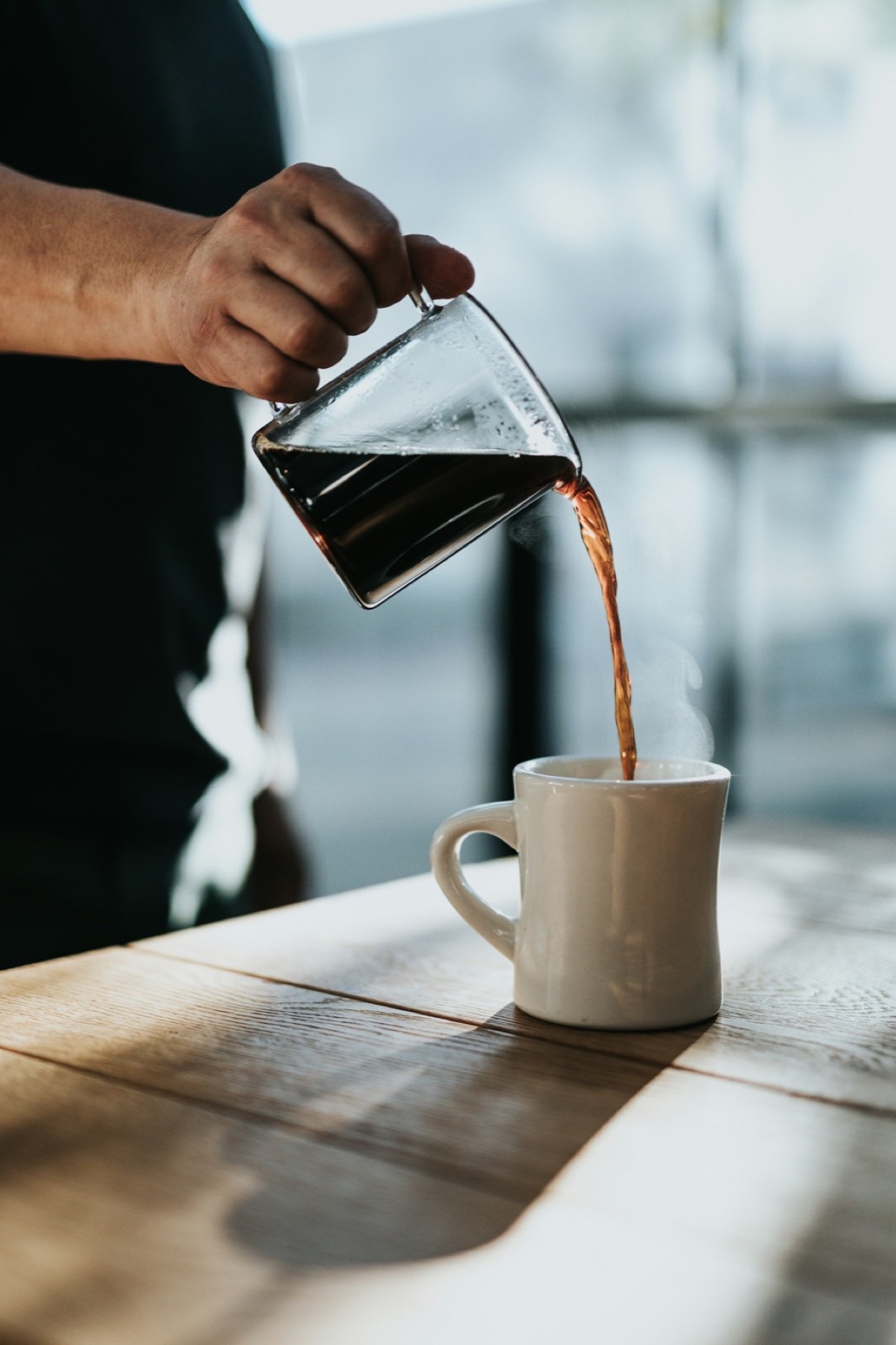
Two cold-brew recipes that look identical on paper can land a full percentage point apart in strength, because three decisions are usually folded into a single line of instructions. Ratio sets how strong the concentrate is. Time and temperature set how much material that concentrate carries. Dilution sets what actually reaches the glass. A peer-reviewed comparison of cold-brew methods documents all three as independent variables [1], and keeping them apart is what makes a recipe portable between a fridge, a counter and a bottle of water.
Three decisions behind one recipe
Cold brew is a family of methods rather than one method: what defines it is the temperature of the water, which the comparison places in the 0–15 °C range [1]. Cold water extracts slowly enough that the same study puts the time required at roughly 100 times that of a hot brew [1]. Every published cold recipe is therefore a trade between how long you wait and how strong a concentrate you are willing to handle, and dilution is the step that turns whichever concentrate you made into a drink.
Ratio: the 1:10 concentrate
What the comparison brews, side by side [1]:
- Traditional cold brew: 40 g of coffee to 400 g of water, a 1:10 ratio, held at 4 °C for 24 hours.
- Ice drip: 40 g of coffee under 100 g of ice and 300 g of water, again 1:10, dripping at about one drop every 2 seconds for 6 hours at 20 ± 3 °C.
- A reduced-pressure cycle: 1:14, run as two cycles of 5 minutes at 205 mbar.
- An ultrasonic-assisted brew: 1:18 for 1 hour, which raised total dissolved solids by 6–26% against the same immersion time.
- High-pressure processing: 300 MPa for 30 minutes, placed by the authors alongside 12 hours of traditional extraction.
Every one of those recipes used coffee ground and sieved to 250–595 µm [1] — finer than the 800 µm median measured for AeroPress brewing in a separate comparison of filter methods [3], which is the clearest single reason cold water needs so much contact time. The 1:10 concentrate is the one to start from if you intend to dilute; the 1:14 and 1:18 variants are already close to drinking strength.
Time and temperature as one dial
Time and temperature are not two decisions but one. The same extraction can be bought with 24 hours at 4 °C, with 6 hours of ice dripping at room temperature, or with 30 minutes under pressure [1]. Move the dial and you are choosing a different drink rather than a faster version of the same one.
Aroma analysis in that study shows how literal the difference is. Linalool, the floral note, reached an odour activity value of 100.50 in the ice-drip brew, while 2-methyl-5-propylpyrazine, a roasted-nut note, led the fridge brew at 17.70 [1]. Of 48 volatiles detected, 17 crossed the odour activity threshold at which a compound contributes to what you smell [1]. The 1:10 ratio was constant across those two brews; only the time-and-temperature route differed.
Extraction arithmetic: from yield to strength
A refractometer reports total dissolved solids (TDS) in the finished liquid, and extraction yield follows from it: dissolved solids in the beverage divided by the dry coffee mass [1]. The arithmetic can be done before brewing anything.
Take 100 g of coffee and 1000 g of water — a 1:10 concentrate. Published filter protocols retain about 2.1 times the coffee mass in the spent bed [3], so roughly 200 g of the water stays in the grounds and about 800 g of concentrate comes out. At a 20% extraction yield, 20 g of the coffee is dissolved in that 800 g, giving a TDS of 2.5%. Move the yield and the strength moves with it:
| Extraction yield | Dissolved solids | Concentrate TDS |
|---|---|---|
| 18% | 18 g | 2.25% |
| 20% | 20 g | 2.50% |
| 22% | 22 g | 2.75% |
The targets usually quoted for filter coffee — an 18–22% extraction band at a strength of 1.15–1.35% TDS — are the figures peer-reviewed work attributes to the SCA Golden Cup Standard [4]. The 2.5% concentrate above sits well outside that strength band, which is the arithmetic reason a concentrate gets diluted before it is drunk.
Dilution is its own decision
Dilution divides the concentrate: one part of water to one part of concentrate halves the TDS, two parts leave a third, three parts leave a quarter. Starting from the 2.5% concentrate, that gives 1.25% at 1:1, 0.83% at 1:2 and 0.63% at 1:3 — a spread that brackets the strength of a filter or drip cup.
The same division scales the batch. Eight hundred grams of concentrate diluted 1:2 becomes 2400 g of drink, or twelve 200 mL glasses. At a listed $21.95 per pound of beans [6], the 100 g dose costs about $4.83, so a glass works out at roughly 40 cents before water, filters or time. A stronger ratio is not cheaper per glass; it simply puts the same coffee into fewer, smaller servings.
Because dilution water is part of the drink, the brewing-water targets in the comparison above apply to it as well: calcium hardness between 50 and 175 ppm as CaCO₃, a pH of 6.5–7.5, and dissolved solids of 75–250 mg/L, with 100–150 mg/L as the figure to aim for [3].
What cold extraction changes in the cup
Cold brew is not a milder pour-over. In a sensory comparison of full immersion brewing, the cold version read as more floral and less bitter, sour and rubbery than the hot one [2]. Method matters inside the cold family too: ice drip and fridge immersion separated on different dominant aroma compounds at the same 1:10 ratio [1], and a wider comparison of brewing methods reports that the bioactive and mineral composition of the cup tracks the way it was brewed [5].
Those results are the argument for keeping the dials separate. Ratio, time-and-temperature and dilution each change something different, and none of them substitutes for the others.
Method: This page works from a peer-reviewed comparison of cold-brew methods that reports ratio, temperature, time, particle size and dissolved-solids data for each, from the extraction arithmetic those figures imply, and from a published retail price for the coffee itself.
Boundary: The numbers describe immersion and drip cold brewing of roasted coffee at the 1:10 to 1:18 ratios used in the studies cited, including the pressure-assisted and ultrasonic variants. Strength after dilution follows from the two tables above, and the glass count follows from the batch size you choose.
- Foods (2025), 14(16):2840 — cold brew compared with ice-drip and high-pressure carbon dioxide extraction (doi:10.3390/foods14162840)accessed 2026-09-11
- Foods (2022), 11(16):2440 — Sensory Analysis of Full Immersion Coffee: Cold Brew Is More Floral, and Less Bitter, Sour, and Rubbery Than Hot Brew (doi:10.3390/foods11162440)accessed 2026-09-11
- Discrimination of Filter Coffee Extraction Methods of a Medium Roasted Specialty Coffee Based on Volatile Profiles and Sensorial Traits — Foods 12(17):3199 (2023), doi:10.3390/foods12173199accessed 2026-09-11
- Batali ME, Ristenpart WD, Guinard J-X — Brew temperature, at fixed brew strength and extraction, has little impact on the sensory profile of drip brew coffee, Scientific Reports 10:16450, 2020; quotes the SCA Golden Cup Standard of 18–22% extraction at 1.15–1.35% TDSaccessed 2026-09-12
- Molecules (2025), 30(20):4080 — Influence of Brewing Methods on the Bioactive and Mineral Composition of Coffee Beverages (doi:10.3390/molecules30204080)accessed 2026-09-11
- Peet's Coffee — Major Dickason's Blend, listed retail price $21.95 per poundaccessed 2026-09-11
Set the ratio to 1:10, pick a time-and-temperature route from the two documented pairs, then do the division that puts the drink at drinking strength [1]. That order is the whole method: three decisions, each with its own number, none of them hiding inside the others.