Coffee travelled as a cargo before it travelled as a habit, and the stops on the route carry dates. Two kinds of record supply them: genetic and traceability research, which places the domestication of the cultivated plant in the Yemeni highlands and names the governorates that still grow it, and the chronicle, archive and museum record, which fixes the rooms where the drink was sold — Tahtakale in the 1550s, London in 1652 and 1679, and a village counter in the 1790s.
Treat the room as cargo and the story becomes a sequence of dated stops rather than a list of famous addresses. Each stop needs the same three things — a port or market that handles the raw material, a building type that can be copied, and people who have already used the format elsewhere and can describe it to a builder. The sections below follow those requirements from the Yemeni governorates that still supply the crop, through Istanbul in the 1550s, London in 1652 and 1675, an English village counter in the 1790s, and two museum objects dated to the 1830s.
The highlands the cargo came from
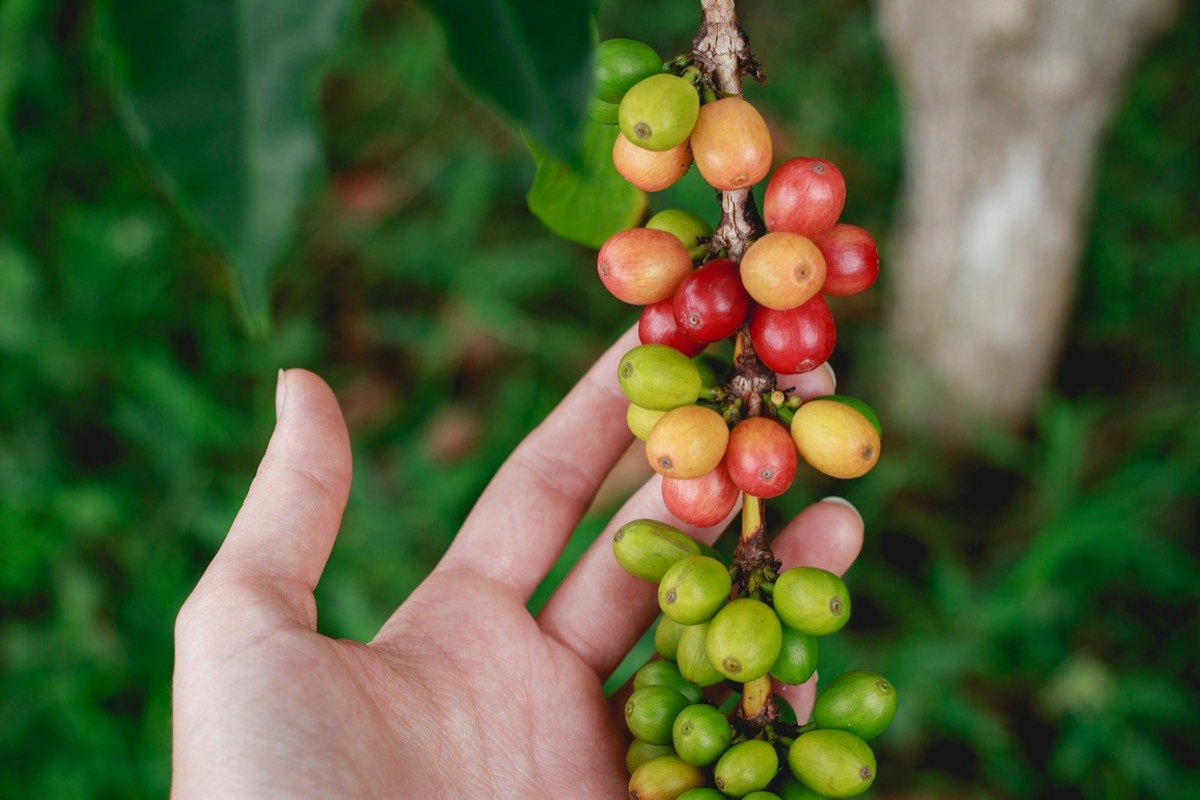
The chain this page follows starts in the Yemeni highlands, and the starting point is documented at population level rather than asserted. A review chapter on the history and genetic diversity of cultivated Coffea arabica distinguishes the species' centre of origin, where wild populations have recently been recorded in South Sudan, from its centre of domestication, for which the chapter reports new genetic data from Yemen. A separate traceability study of Yemeni green coffee names the five governorates that still supply the crop — Al Mahwit, Dhamar, Ibb, Sa'dah and Sana'a — and estimates the country's smallholder coffee farmers at 150,000, describing their holdings as mountain plots worked with manual post-harvest methods.
The direction of travel is what matters for a route. Supply came from terraced smallholdings rather than from estates, so the lots entering trade began as small consignments gathered from scattered farms, and the market quarters where the drink was first sold sat downstream of that gathering. The same traceability study states that both coffee cultivation and the coffee trade began in Yemen. What the chronicle record then dates is the finished drink acquiring its own building, and the route it takes north runs through the Syrian trading cities rather than straight out of the producing highlands.
Tahtakale, 1554: a format gets its first address
The coffeehouse acquired a street address before it acquired a reputation for argument. Its earliest known premises are recorded in Istanbul in the 1550s, in the Tahtakale quarter, where the chronicle account that Eminegül Karababa and Güliz Ger's consumer-culture study traces to the historian İbrahim Peçevi names two keepers, both recent arrivals from Aleppo and Damascus. That detail is the route in miniature: the institution reaches Istanbul through the Syrian trading cities, carried by named tradesmen with a business model, rather than arriving straight from the Yemeni highlands where the plant was domesticated.
Position mattered as much as the recipe. Tahtakale sits inside the market district, a short haul from the quays where goods were landed and the covered market where they were sold, so a shop could restock beans, fuel and cups without owning a warehouse. Once beans and a rented room existed, the format could be copied by anyone with stock and premises, and copying is what turns a single address into a category of business. Within two generations the same room type appears across the Ottoman market quarters, which is why the earliest European coffeehouses open in ports that already traded with those cities.
1652 for the room, 1679 for the bathhouse
The London room can be dated against a second imported building type. The same account places the city's first Turkish bath in 1679: a building modelled on Ottoman design, with a central cold bath, alcoves holding warm baths and a sweating room, and a clientele that included both sexes on different days and a range of social classes. Two imported building types, twenty-seven years apart, on the same side of the water.
The interval between them is the clearest evidence that what moved was a format rather than only a drink. A bathhouse carries no cargo that has to be landed and roasted; it exists only if travellers can describe it — the sequence of cold plunge, warm alcove and sweating room — to a bricklayer in London. Coffee needed the same descriptive traffic plus a supply chain, which is why the commercial room arrived first. Ports that already handled Levantine goods had the merchants, the credit and the returning travellers to make the copy possible.
1675: a port city's rooms become a government problem
The political cost of the format surfaced in 1675. Charles II, according to the same account, was troubled that the rooms were being used to "spread scandalous reports concerning the conduct of his Majesty and his Ministers", and his attempt to suppress them was reversed after public opposition. Enforcement came from the centre; resistance came from the clientele, and the clientele was the reason the rooms existed.
A coffeehouse in a port city did work no harbour office did. Arrivals, cargoes, losses and prices were pooled and repeated in one room, and information of that kind carries a price, so the merchants and brokers who used the room to trade had a commercial interest in keeping the door open. The premises were also taxable businesses. Attempt, backlash, retreat — the sequence in 1675 is the pattern later regulation of the trade follows.
The state's own paper for the ban year survives in digitised form: British History Online publishes the Calendar of State Papers Domestic for Charles II, 1675–6, which calendars the domestic correspondence of those two years and is where talk inside the rooms enters the official record.
From the quay to the village counter: the 1790s
The next stage of the journey is retail rather than maritime, and it can be counted in product lines. JSTOR Daily's account of the historian Troy Bickham's work describes sugar, tea, coffee and tobacco as goods that were "once exotic" and became "ubiquitous during the long eighteenth century", pushed out by low prices, extensive credit and efficient distribution networks that carried them across what Bickham calls "the geographic and social spectrums" of Great Britain.
The evidence for that spread is a shop ledger rather than a ship's manifest. In the 1790s a village grocery in Shipton-under-Wychwood, in the Cotswolds — Anne Gomm's shop — stocked at least half a dozen types of tea, three types of coffee, several grades of tobacco, sugar, orange peel, confectionery, chocolate, and spices running from nutmeg to black pepper. Three types of coffee on one village counter is a market fact: the customer was choosing between qualities and prices instead of taking a single article off the shelf. The port is the first node in the chain, and the number of lines on a Cotswold counter measures how far downstream the chain had reached by the last decade of the eighteenth century.
What the objects record: 1838, and traffic running the other way
The material trail runs back the other way in the nineteenth century. The Victoria and Albert Museum holds Thomas Allom's watercolour "Interior of a Turkish Caffinet, Constantinople", painted in 1838 and reproduced as an etching for the Reverend Robert Walsh's Constantinople and the Scenery of the Seven Churches of Asia Minor, published in the same year; Walsh's text calls the caffinet "something more splendid", the Turk's "favourite place of indulgence" (p. 59). The museum's own record describes the type: timber-framed rooms with carved and painted rococo interiors and small fountains to cool the air in summer, where customers drank coffee, listened to music, were shaved, smoked pipes, heard storytellers or simply sat. Because the structures were wooden and Istanbul burned often, the cataloguers doubt that a single nineteenth-century rococo coffee house still stands.
The same museum holds a coffee pot made at Kütahya, an Anatolian potting town whose workshops supplied the empire's ceramic trade — a vessel record rather than a picture of a room. Set beside the 1838 watercolour, the two objects show the traffic reversed from 1652: European artists making dated images on the Ottoman side of the trade and feeding them back into European print culture, carrying the room westward to readers who would never sit in one.
Method: The page combines two evidence layers. The botanical and traceability layer uses a 2025 review chapter on the history and genetic diversity of cultivated Coffea arabica, in Advances in Botanical Research, for the distinction between the species' centre of origin and its centre of domestication, and a 2024 study in Scientific Reports on the near-infrared identification of Yemeni green coffee for the five producing governorates and the 150,000 smallholder estimate. The documentary layer uses the study of Ottoman-inspired building types in Europe reported by JSTOR Daily — Deborah Howard, "Architectural Encounters: Ottoman-Inspired Typologies in Europe as Liminal Social Space", Artibus et Historiae, vol. 42, no. 83 (2021), pp. 297–312 — for the 1652 London coffeehouse, the 1679 Turkish bath and the 1675 royal complaint; the same outlet's report of Troy Bickham's work on imperial consumption for eighteenth-century distribution and the 1790s shop inventory; Eminegül Karababa and Güliz Ger's study of early modern Ottoman coffeehouse culture in the Journal of Consumer Research for the 1550s Tahtakale address and its Aleppo and Damascus keepers; the digitised Calendar of State Papers Domestic: Charles II, 1675–6 at British History Online for the documentary layer of the ban year; and the Victoria and Albert Museum's own catalogue entries for the 1838 watercolour with its printed source and for the Kütahya pot.
Boundary: Coverage runs from the Yemeni highlands as the documented centre of domestication to European pictures of the 1830s, and it follows the movement of the drink, the room and its equipment between Ottoman and European cities. The eighteenth-century transplantation of the coffee tree to Java, the Caribbean and Brazil, the founding dates of the first coffeehouses in Venice and Marseille, the Yemeni seamen who later kept coffee rooms in British ports, and the tonnage figures of the later export trade lie outside this page.
- Santos-Rivera, M., Montagnon, C. & Sheibani, F. — Identifying the origin of Yemeni green coffee beans using near infrared spectroscopy: a promising tool for traceability and sustainability, Scientific Reports 14 (2024)accessed 2026-09-11
- Montagnon, C., Sheibani, F. & Bertrand, B. — The history and genetic diversity of cultivated Coffea arabica, Advances in Botanical Research 114 (2025), pp. 1–28 (Europe PMC record IND608791661)accessed 2026-09-11
- JSTOR Daily — Bringing Turkish Style to Europe (reporting Deborah Howard, "Architectural Encounters: Ottoman-Inspired Typologies in Europe as Liminal Social Space", Artibus et Historiae, vol. 42, no. 83, 2021, pp. 297–312)accessed 2026-09-11
- JSTOR Daily — Consuming the Empire (quoting the historian Troy Bickham)accessed 2026-09-11
- Victoria and Albert Museum — Interior of a Turkish Caffinet, Constantinople, Thomas Allom, watercolour, 1838 (object O136488)accessed 2026-09-11
- Victoria and Albert Museum — Coffee pot, Kütahya ware (object O85345)accessed 2026-09-11
- Karababa, E. & Ger, G. — Early Modern Ottoman Coffeehouse Culture and the Formation of the Consumer Subject, Journal of Consumer Research (2005). doiaccessed 2026-09-11
- British History Online — Calendar of State Papers Domestic: Charles II, 1675–6accessed 2026-09-11
The chain runs from terraced farms in Al Mahwit, Dhamar, Ibb, Sa'dah and Sana'a to three types of coffee on a Cotswold counter in the 1790s and a dated watercolour of an Istanbul coffee house in 1838. Two of those stops are ports and two are interiors, and each depends on the one before it: the producing governorate supplies the beans, the trade city supplies the copyists, and the museum catalogue is where the copied room ends up once its timber version has burned.