A brewer is a set of four constraints wearing a product name: how much coffee it can hold, how many minutes you have to stand next to it, how many parts end up in the sink, and what it costs on the page you buy it from. All four are countable before you own anything, and they narrow the field faster than any tasting note does.
The two figures that do the most work are capacity and hands-on time. A full batch on the Moccamaster KBGV Select is 1.25 L, listed at $369.00 with a 1,475 W element and an auto-off at 100 minutes [1]. Breville's Precision Brewer is built around 60 oz, which is 1.8 L, and its page lists a set of presets that includes a Gold Cup profile, PID temperature control, three flow rates and adjustable bloom [2]. Convert both to 250 mL mugs and the difference is concrete: the KBGV Select fills five, the Precision Brewer fills seven.
Four countable constraints, before any brand
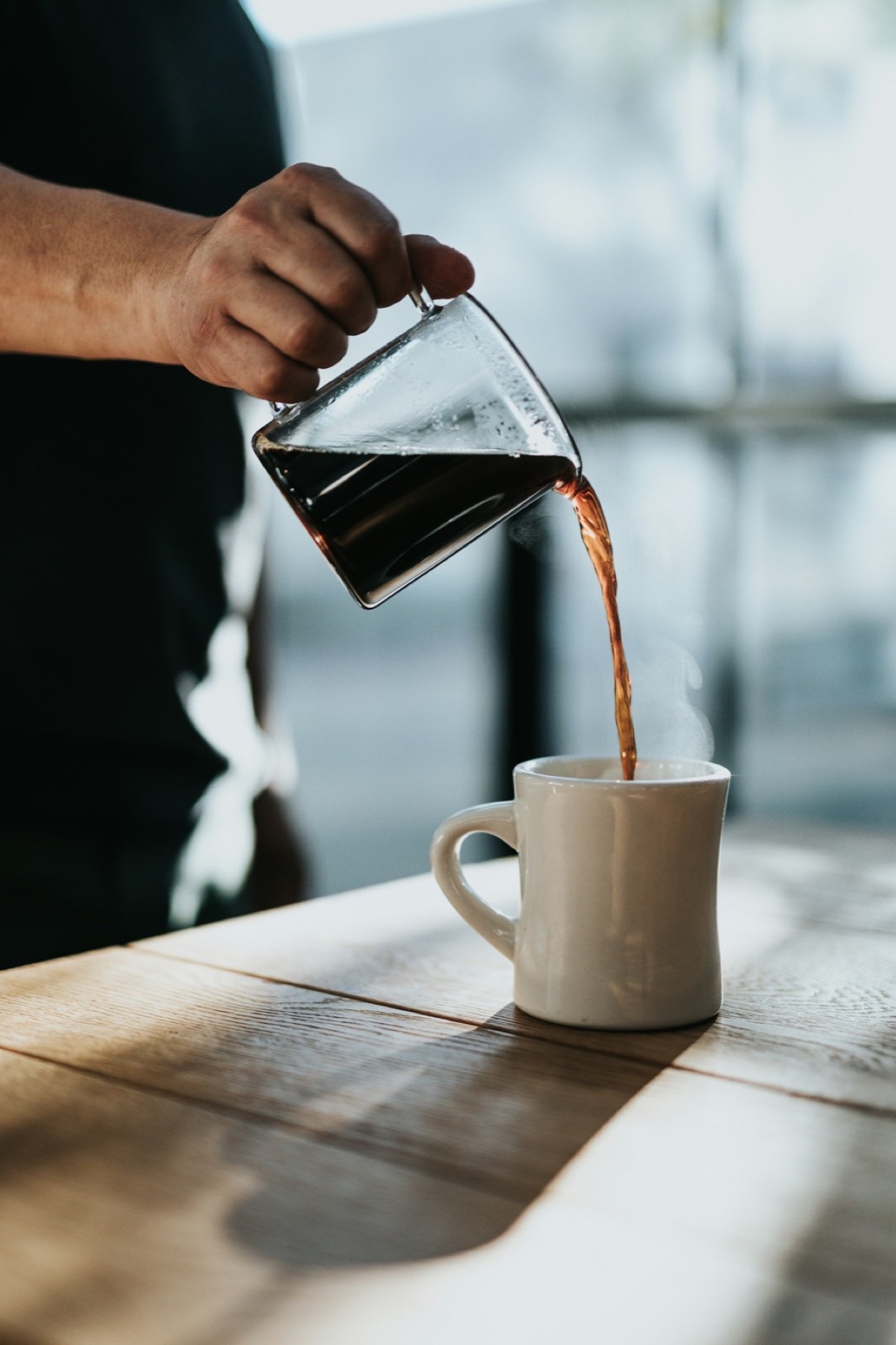
Start with volume per cycle. A 250 mL mug is the unit most households actually drink, so a five-mug pot means 1.25 L and a seven-mug machine means 1.8 L. If you drink two mugs a day, a five-mug pot covers two days and one refill per week; if four people leave the house at the same time, a five-mug pot covers the whole table in one cycle and the seven-mug machine leaves coffee standing.
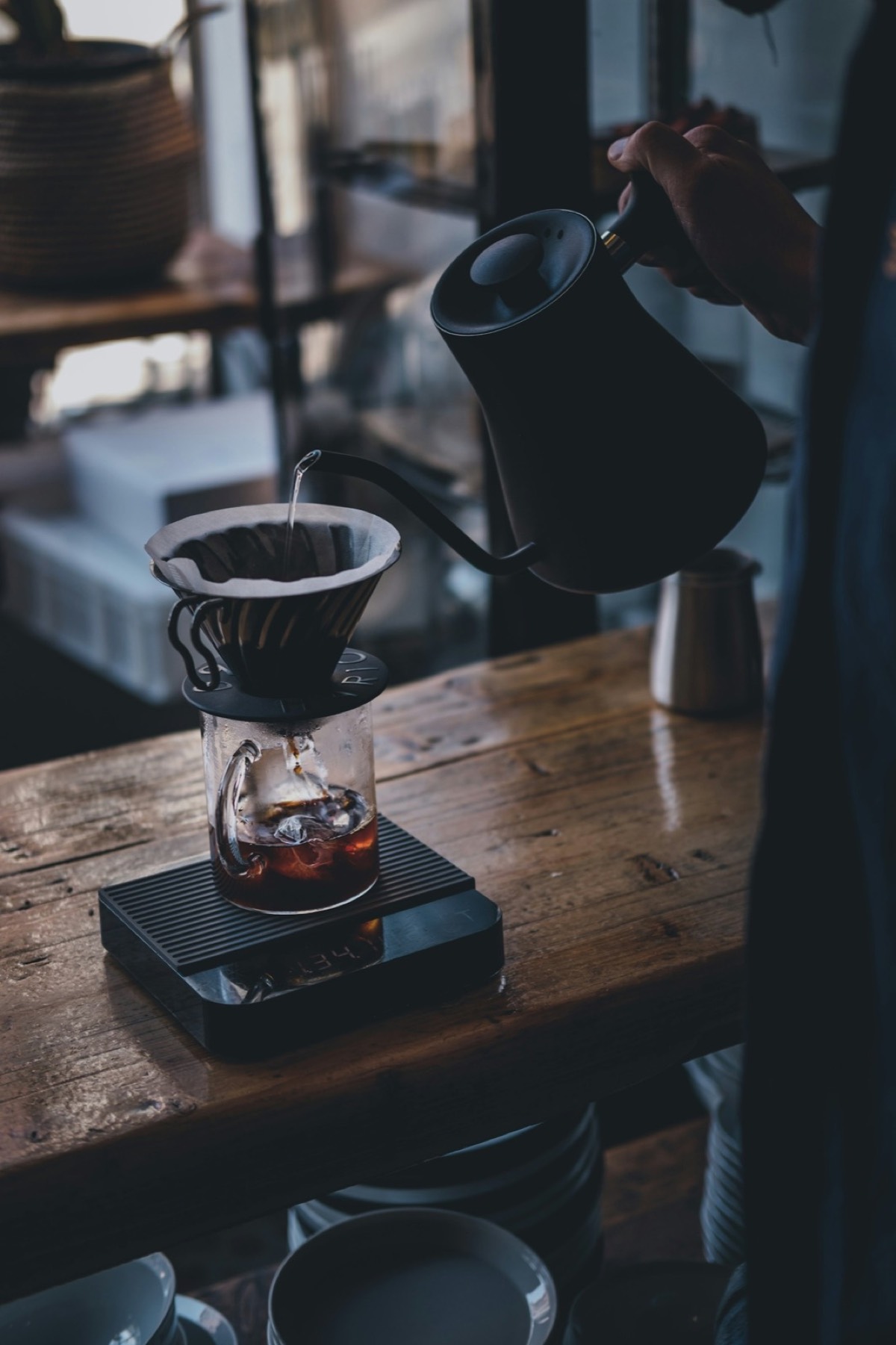
Then count hands-on minutes rather than total minutes. Batch brewers ask for grinding, loading and a switch; a manual pour-over asks for the whole brew, which the published V60 protocol paces at 1:15 with water at 93 °C [6]. The pour-over measurement that surprises people is retention: a wet bed holds roughly 2.1 times the coffee mass, so a 20 g dose losing that much water yields about 290 mL in the server rather than the 300 mL the ratio promised [6]. A drip machine's basket holds back a comparable amount, but you never watch it happen.
The third constraint is the number of surfaces that need washing, and the fourth is the listed price — the $369.00 the KBGV Select lists [1] against pour-over hardware, where a dripper, a kettle and a server are bought as three separate listings rather than one machine price [4].
Batch brewing: what the numbers actually cover
The Moccamaster KBGV Select is a copper-element batch brewer with a 1.25 L (40 oz) glass carafe, a 1,475 W element at 120 V, a 14 in × 12.75 in × 6.50 in footprint, a 6.00 lb shipping weight, a 100-minute auto-off and a five-year warranty; the maker certifies it against the SCA and ECBC brewing programmes and recommends a medium-coarse grind [1]. In routine terms, that is a machine you load and leave: the element does the work at full power and the carafe holds the result warm.
The Precision Brewer's spec sheet points at a different habit. Its tank holds 60 oz — 1.8 L by conversion — and the presets, PID control, three flow rates and adjustable bloom describe a machine that changes its own pour pattern rather than one that asks you to change yours [2]. Breville no longer lists a purchase price on that product page, so the capacity and control figures are what the page will give you [2].
Hands-on minutes against unattended minutes
Put the two drip machines beside the two manual methods and the real trade is attention, not quality. A batch brewer converts about a minute of your hands into 1.25–1.8 L of coffee. A pour-over converts three to five minutes of standing at the counter into 250 mL, and the V60 protocol above is a single serving at the protocol's 1:15 [6]. Espresso sits at the other extreme: a published espresso protocol extracts in 25 s ± 3 s at about 9 bar, which is less total time than a pour-over and far more preparation per millilitre [8].
That is the arithmetic behind a routine: divide the volume you drink by the attention you are willing to give it. Five mugs in one cycle at the price of one switch is the batch brewer's whole case. One carefully paced 250 mL cup is the pour-over's.
Cleaning, counted in surfaces rather than products
Every class of brewer puts a different number of parts in the sink, and the count is what you actually own after the first week.
Batch and programmable drip machines put three things in the sink: the filter basket, the carafe or thermal server with its lid, and — occasionally — the water reservoir. The descaling side runs on water rather than coffee, which is why the Precision Brewer ships with a water hardness test strip: the strip reading is the input that tells you when the water side needs attention rather than a fixed calendar [2].
Manual pour-over swaps the basket for a paper filter and a cone, so the daily count is one paper, one cone and one server. At 250 mL per brew, it takes seven papers and seven rinses to equal one 1.8 L drip cycle [2][6]. Paper also holds back oils and fine particles, which is the mechanical reason a filter cup and an immersion cup of the same coffee do not taste alike [9].
What a mug costs and how much caffeine it carries
Ingredient cost scales with grams, not with machine class. A 250 mL mug brewed at 60 g per litre (the automated-filter strength in the published filter comparison) uses 15 g, and a batch at 1.25 L needs 75 g of coffee — both read straight off the ratios above [1][6]. What those grams cost follows the price per pound of the blend you buy: Peet's lists Major Dickason's at $21.95 per pound (16 oz, 453.6 g by conversion) and prints its own figure of 48 cents per serving across about 45 servings per pound [5]. A 15 g mug dose works out to roughly 73 cents, and the 75 g behind a 1.25 L batch to about $3.63, both read off that per-pound price rather than the machine class they are brewed on [1][5].
Caffeine follows serving volume just as closely. Measured per serving, a 250 mL V60 cup contains 185.48 mg, a French press cup of the same size 206.88 mg, and a plain infusion 195.90 mg, while a 25 mL espresso shot contains 63.06 mg [7]. A five-mug KBGV Select cycle, if it matches the V60 strength, carries about 927 mg of caffeine in the carafe — roughly fifteen espresso shots' worth of stimulant spread across 1.25 L [1][7].
The routine table, and how to read it
| What you compare | Batch drip (glass carafe) | Programmable drip | Manual pour-over | Immersion |
|---|---|---|---|---|
| Capacity per cycle | 1.25 L / 40 oz / 10 cups [1] | 1.8 L / 60 oz [2] | about 250 mL per brew [6] | 150 mL to 1 L depending on vessel [9] |
| Listed price | $369.00 [1] | not listed on the product page [2] | dripper, kettle and server, each a separate listing [4] | covered by the same hardware range [4] |
| Hands-on time per cycle | load and switch, then unattended [1] | load, choose a preset, then unattended [2] | the full brew, paced by hand [6] | pour, wait, plunge or decant |
| Surfaces to wash | basket, carafe, lid [1] | basket, server, lid, reservoir [2] | one paper, cone, server [6] | press body, plunger, mesh [9] |
| Water-side care | hardness-dependent descaling | hardness test strip supplied [2] | kettle descaling | kettle descaling |
| Brew strength reference | medium-coarse grind [1] | Gold Cup preset [2] | 1:15 at 93 °C [6] | 0.055 g/mL cupping strength, 8.25 g per 150 mL [9] |
Read the table as a sequence of elimination steps rather than a scoreboard. Cross off any machine whose capacity cannot cover the number of mugs you pour before you leave. Then cross off the ones whose hands-on time you will not spend on a weekday. Then compare the two survivors on wash-up and price, because that is the part of the routine that repeats 300 times a year.
Method: This page compares brewer classes using the manufacturers' published product pages for capacity, power, warranty and certified programmes, the Specialty Coffee Association's home-brewer standard (SCA-310) [3], a peer-reviewed comparison of filter extraction methods, and a peer-reviewed study of caffeine by brewing method.
Boundary: The figures describe each brewer as it is published and sold — litres per cycle, watts, listed price, brew ratio and caffeine per serving — so the comparison holds across classes. Which cup a drinker prefers within those classes comes down to the coffee, the grinder and the recipe, and those are the variables a brewer does not set.
- Moccamaster — KBGV Select (US product page, listed at $369.00 on the access date — the site's current promotional price rather than a list price; 1.25 L / 40 oz / 10 cups, 1,475 W at 120 V, 100-minute auto-off, 5-year warranty, ECBC-certified and SCA-approved)accessed 2026-09-12
- Breville — the Precision Brewer (BDC400) (US product page, now marked discontinued; 60 oz, Gold Cup preset, PID control, three flow rates, water hardness test strip; no price listed)accessed 2026-09-12
- Specialty Coffee Association — Coffee Standards (published list that includes SCA-310 Home Coffee Brewers: Specifications and Test Methods; the standard itself is member-restricted)accessed 2026-09-12
- Seattle Coffee Gear — Pour-over (category listing for drippers, kettles and servers; no price range is quoted)accessed 2026-09-12
- Peet's Coffee — Major Dickason's Blend (roaster product page, listed at $21.95 per pound and priced by the roaster at 48 cents per serving across 45 servings)accessed 2026-09-12
- Discrimination of Filter Coffee Extraction Methods of a Medium Roasted Specialty Coffee Based on Volatile Profiles and Sensorial Traits. Foods (2023). doi:10.3390/foods12173199accessed 2026-09-11
- Influence of Brewing Methods on the Bioactive and Mineral Composition of Coffee Beverages. Molecules (2025). doi:10.3390/molecules30204080accessed 2026-09-11
- Cross-Cultural Comparison of the Espresso Protocol Repeatability. Foods (2025). doi:10.3390/foods14040593accessed 2026-09-11
- Does Coffee Have Terroir and How Should It Be Assessed? Foods (2022). doi:10.3390/foods11131907accessed 2026-09-11
The list above mixes two kinds of source on purpose: manufacturer product pages for capacity, power, price and included accessories, and peer-reviewed papers for brew ratios, retention and caffeine per serving. Where a figure turns on a price or a live listing, the date it was checked travels with it.